Showing posts with label Cathy O'neil. Show all posts

Friday, January 11, 2019

To get better at math, act like someone who loves math


Miles Kimball, Quartz

If the “love it and learn it” hypothesis is true, it gives a simple recommendation for someone who wants to get better at math: spend more time thinking about and working on math. Best of all: spend time doing math in the kinds of ways people who love math spend time doing math. Think of math like reading. Not everyone loves reading. But all kids are encouraged to spend time reading, not just for school assignments, but on their own. Just so, not everyone loves math, but everyone should be encouraged to spend time doing math on their own, not just for school assignments. If a kid has a bad experience with trying to learn to read in school, or is bored with the particular books the teacher assigned, few parents would say “Well, maybe you just aren’t a reader.” Instead, they would try hard to find some other way to help their kid with reading and to find books that would be exciting for their particular kid. Similarly, if a kid has a bad experience trying to learn math in school, or is bored with some bits of math, the answer isn’t to say “Well maybe you just aren’t a math person.” Instead, it is to find some other way to help that kid with math and to find other bits of math that would be exciting for their particular kid to help build her or his interest and confidence.
The way a teacher presents a mathematical principle or method in class may not work for you—or, as Elizabeth Green suggested in the New York Times, the whole American pattern of K-12 math instruction may be fatally flawed. If you loved math, you would think about that principle or method from many different angles and look up and search out different mathematical resources, until you found the angle that made most sense to you. Even if you don’t love math, that would be a good way to approach things.
Many people think that because they can’t understand what their math teacher is telling them, it means they can’t understand math. What about the possibility that your teacher doesn’t understand math? Some people are inspired to a life-long love of math by a great math teacher; others are inspired to a life-long hatred of math by an awful math teacher. If you are unlucky enough to have an awful math teacher, don’t blame math for your teacher’s failings.
Cathy O’Neil—who blogs at mathbabe.org—describes well what I like to call “slow-cooked math”:
There’s always someone faster than you. And it feels bad, especially when you feel slow, and especially when that person cares about being fast, because all of a sudden, in your confusion about all sort of things, speed seems important. But it’s not a race. Mathematics is patient and doesn’t mind.
Being good at math is really about how much you want to spend your time doing math. And I guess it’s true that if you’re slower you have to want to spend more time doing math, but if you love doing math then that’s totally fine.
I was lucky to have a dad and older brother who showed me a bit of math early on, in a way that was unconnected to school. Then in school, I spent at least as much time on math when I wasn’t supposed to be doing math as when I was. It was a lot more fun doing math when I wasn’t supposed to be doing math than when I was.
For one thing, when I did it on my own, I could do it my own way. But also, there were no time limits. It didn’t matter if it took me a long time. And nothing seemed like a failure.
I spent a lot of time doing math. And very little of that math was done under the gun of a deadline. I spent some time on literal tangents in geometry and trigonometry. But I spent a lot more time on figurative tangents, running into mathematical dead ends. When Euclid told King Ptolemy “there is no Royal Road to geometry,” it had at least two meanings:
  1. Everyone—even a king or queen—has to work hard if he or she wants to learn geometry or any other bit of higher math.
  2. The path to learning geometry, or math in general, is not always a straight line. You may have to circle around a problem for a long time before you finally figure out the answer.

Tuesday, March 21, 2017

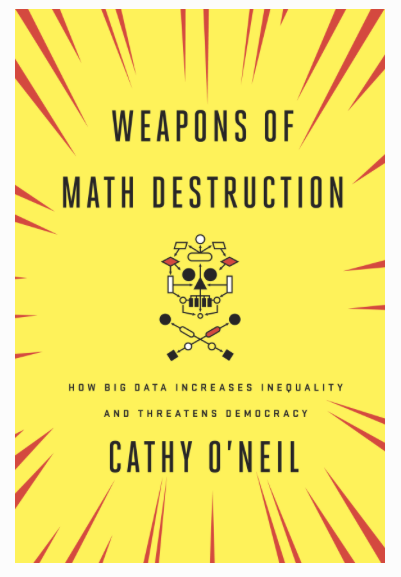
Weapons of Math Destruction


The problem is that they’re feeding on each other. Poor people are more likely to have bad credit and live in high-crime neighborhoods, surrounded by other poor people. Once the dark universe of WMDs digests that data, it showers them with predatory ads for subprime loans or for-profit schools. It sends more police to arrest them, and when they’re convicted it sentences them to longer terms. This data feeds into other WMDs, which score the same people as high risks or easy targets and proceed to block them from jobs, while jacking up their rates for mortgages, car loans, and every kind of insurance imaginable. This drives their credit rating down further, creating nothing less than a death spiral of modeling. Being poor in a world of WMDs is getting more and more dangerous and expensive.

The same WMDs that abuse the poor also place the comfortable classes of society in their own marketing silos. They jet them off to vacations in Aruba and wait-list them at Wharton. For many of them, it can feel as though the world is getting smarter and easier. Models highlight bargains on prosciutto and chianti, recommend a great movie on Amazon Prime, or lead them, turn by turn, to a café in what used to be a “sketchy” neighborhood. The quiet and personal nature of this targeting keeps society’s winners from seeing how the very same models are destroying lives, sometimes just a few blocks away.


Our national motto, E Pluribus Unum, means “Out of Many, One.” But WMDs reverse the equation. 


**
“When automatic systems sift through our data to size us up for an e-score, they naturally project the past into the future. As we saw in recidivism sentencing models and predatory loan algorithms, the poor are expected to remain poor forever and are treated accordingly—denied opportunities, jailed more often, and gouged for services and loans. It’s inexorable, often hidden and beyond appeal, and unfair.”

**
Mathematical models can sift through data to locate people who are likely to face great challenges, whether from crime, poverty, or education. It’s up to society whether to use that intelligence to reject and punish them—or to reach out to them with the resources they need. We can use the scale and efficiency that make WMDs so pernicious in order to help people. It all depends on the objective we choose.

**


While looking at WMDs, we’re often faced with a choice between fairness and efficacy. Our legal traditions lean strongly toward fairness. The Constitution, for example, presumes innocence and is engineered to value it. From a modeler’s perspective, the presumption of innocence is a constraint, and the result is that some guilty people go free, especially those who can afford good lawyers. Even those found guilty have the right to appeal their verdict, which chews up time and resources. So the system sacrifices enormous efficiencies for the promise of fairness. The Constitution’s implicit judgment is that freeing someone who may well have committed a crime, for lack of evidence, poses less of a danger to our society than jailing or executing an innocent person.


WMDs, by contrast, tend to favor efficiency. By their very nature, they feed on data that can be measured and counted. But fairness is squishy and hard to quantify. It is a concept. And computers, for all of their advances in language and logic, still struggle mightily with concepts. They “understand” beauty only as a word associated with the Grand Canyon, ocean sunsets, and grooming tips in Vogue magazine. They try in vain to measure “friendship” by counting likes and connections on Facebook. And the concept of fairness utterly escapes them. Programmers don’t know how to code for it, and few of their bosses ask them to.


So fairness isn’t calculated into WMDs. And the result is massive, industrial production of unfairness. If you think of a WMD as a factory, unfairness is the black stuff belching out of the smoke stacks. It’s an emission, a toxic one. 


**

“Our own values and desires influence our choices, from the data we choose to collect to the questions we ask. Models are opinions embedded in mathematics.”
**
“The question, however, is whether we’ve eliminated human bias or simply camouflaged it with technology. ”