Showing posts with label Eğitim. Show all posts

Tuesday, June 28, 2022

For Teaching, Philosophy Makes a Difference


What’s the connection between philosophy of mathematics and teaching of mathematics? Each influences the other. The teaching of mathematics should affect the philosophy of mathematics, in the sense that philosophy of mathematics must be compatible with the fact that mathematics can be taught. A philosophy that obscures the teachability of mathematics is unacceptable. Platonists and formalists ignore this question. If mathematical objects were an other-worldly, nonhuman reality (Platonism), or symbols and formulas whose meaning is irrelevant (formalism), it would be a mystery how we can teach it or learn it. Its teachability is the heart of the humanist conception of mathematics.

In the other direction, the philosophy of mathematics held by the teacher can’t help but affect her teaching. The student takes in the teacher’s philosophy through her ears and the textbook’s philosophy through her eyes. The devastating effect of formalism on teaching has been described by others. (See Khinchin or Ernest.) I haven’t seen the effect of Platonism on teaching described in print. But at a teachers’ meeting I heard this:

“Teacher thinks she perceives other-worldly mathematics. Student is convinced teacher really does perceive other-worldly mathematics. No way does student believe he’s about to perceive other-worldly mathematics.” Platonism can justify a student’s certainty that it’s impossible for her/him to understand mathematics. Platonism can justify the belief that some people can’t learn math. Elitism in education and Platonism in philosophy naturally fit together. Humanist philosophy, on the other hand, links mathematics with people, with society, with history. It can’t do damage the way formalism and Platonism can. It could even do good. It could narrow the gap between pupil and subject matter. Such a result would depend on many other factors. But if other factors are compatible, adoption by teachers of a humanist philosophy of mathematics could benefit mathematics education.
**

Political conservatism favors an elite over the lower orders. In mathematics teaching, Platonism suggests that the student either can “see” mathematical reality or she/he can’t.

A humanist/social constructivist/social conceptualist/quasi-empiricist/naturalist/maverick philosophy of mathematics pulls mathematics out of the sky and sets it on earth. This fits with left-wing anti-elitism—its historic striving for universal literacy, universal higher education, universal access to knowledge, and culture. If the Platonist view of number is associated with political conservatism, and the humanist view of number with democratic politics, is that a big surprise?

Monday, January 24, 2022

Math and Life Satisfaction


The better you are at math, the more money seems to influence your satisfaction

Being better at math increases income but also ties satisfaction more closely to money. Jonathan Kitchen/Digital Vision via Getty Images
Pär Bjälkebring, University of Gothenburg and Ellen Peters, University of Oregon

Your grade school math teacher probably told you that being good at math would be very important to your grownup self. But maybe the younger you didn’t believe that at the time. A lot of research, though, has shown that your teacher was right.

We are two researchers who study decision-making and how it relates to wealth and happiness. In a study published in November 2021, we found that, in general, people who are better at math make more money and are more satisfied with their lives than people who aren’t as mathematically talented. But being good at math seems to be a double-edged sword. Although math-proficient people are very satisfied when they have high incomes, they are more dissatisfied, compared to those who aren’t as good at math, when they don’t make a lot of money.

Many researchers have suggested that more money only increases life satisfaction and happiness up to a certain point. Our research modifies this idea by showing that satisfaction derived from income relates strongly to how good a person is at math.

A person holding a pencil above a sheet of paper.
Nearly 6,000 people responded to a survey that asked about math skills, income and life satisfaction. PhotoAlto/Odilon Dimier via Getty Images

A math and happiness test

We investigated the relationship between math ability, income and life satisfaction, using surveys sent to 5,748 diverse Americans as part of the Understanding America Study.

The study included two questions and one test relevant to our research. One question asked participants about their household yearly income. Another one asked respondents to rate how satisfied they are with their lives on a scale of zero to 10.

Finally, people answered eight math questions that varied in difficulty to get a sense of their math skills. For example, one of the moderately difficult questions was: “Jerry received both the 15th highest and the 15th lowest mark in the class. How many students are in the class?” The correct answer is 29 students.

We then combined the results to see how they all related to one another.

Math skills and income also are tied to level of education, so, in our analyses, we controlled for education, verbal intelligence, personality traits and other demographics.

Connecting math skills to income and satisfaction

On average, the better a person was at math, the more money they made. For every one additional right answer on the eight-question math test, people reported an average of $4,062 more in annual income.

Imagine you have two people with the same level of education, one of whom answered none of the math questions correctly and the other answered all of them correctly. Our research predicts that the person who answered all of the questions correctly will earn about $30,000 more each year.

The survey also showed that people who are better at math were, on average, also more satisfied with their lives than those with lower math ability. This finding agrees with a lot of other research and suggests that income influences life satisfaction.

But prior research has shown that the relationship between income and satisfaction is not as straightforward as “more money equals greater happiness.” It turns out that how satisfied a person is with their income often depends on how they feel it compares to other people’s incomes.

Other research has also shown that people who are better at math tend to make more numerical comparisons in general than those who are worse at math. This led our team to suspect that math-proficient people would compare incomes more, too. Our results seem to show just that.

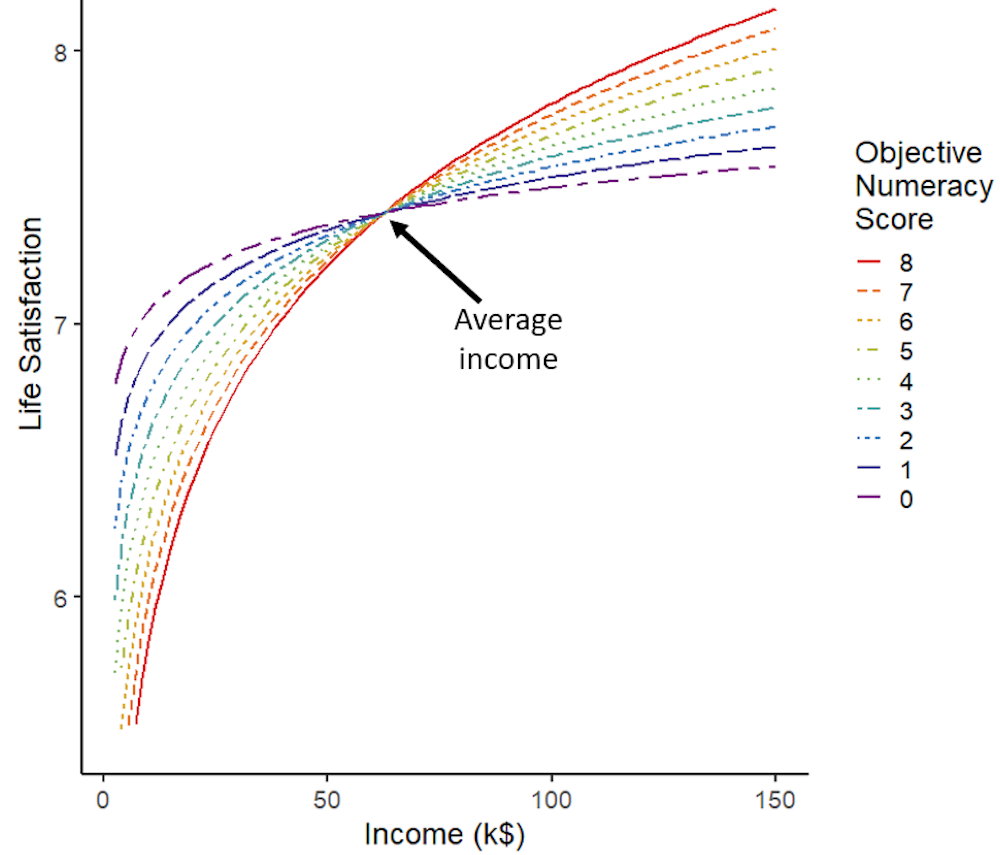
A graph correlating math skills to life satisfaction and income.
This chart shows that people who scored highest on the math test (red line) appear to be happiest when they make a lot of money (top right of graph), but also the least satisfied when they make less money (bottom left of graph). Different color lines correspond to the number of math questions answered correctly. Ellen Peters, Pär Bjälkebring, CC BY-ND

Simply put, the better a person was at math, the more they cared about how much money they make. People who are better at math had the highest life satisfaction when they had high incomes. But deriving satisfaction from income goes both ways. These people also had the lowest life satisfaction when they had lower incomes. Among people who aren’t as good at math, income didn’t relate to satisfaction nearly as much. Thus, the same income was valued differently depending on a person’s math skills.

Money does buy happiness for some

An often-quoted fact – backed up by research – says that once a person makes around $95,000 a year, earning more money doesn’t dramatically increase satisfaction. This concept is called income satiation. Our research challenges that blanket statement.

Interestingly, the people who are best at math did not seem to show income satiation. They were more and more satisfied with more income, and there didn’t appear to be an upper limit. This did not hold true for people who weren’t as talented at math. The least math-proficient group gained more satisfaction from income only until about $50,000. After that, earning more money made little difference.

For some, money does seem to buy happiness. While more work needs to be done to really understand why, we think it may be because math-oriented people compare numbers – including incomes – to make sense of the world. And maybe that’s not always a great thing. In comparison, those who are worse at math appear to derive life satisfaction from sources other than income. So if you are feeling dissatisfied with your income, maybe seeing beyond the numbers will be a winning strategy for you.The Conversation

Pär Bjälkebring, Assistant Professor of Psychology, University of Gothenburg and Ellen Peters, Director, Center for Science Communication Research, University of Oregon

This article is republished from The Conversation under a Creative Commons license. Read the original article.


People who are bad with numbers often find it harder to make ends meet – even if they are not poor


Wändi Bruine de Bruin, USC Dornsife College of Letters, Arts and Sciences and Paul Slovic, University of Oregon

The big idea

People who are bad with numbers are more likely to experience financial difficulties than people who are good with numbers. That’s according to our analyses of the Lloyd’s Register Foundation World Risk Poll.

In this World Risk Poll, people from 141 countries were asked if 10% was bigger than, smaller than or the same as 1 out of 10. Participants were said to be bad with numbers if they did not provide the correct answer – which is that 10% is the same as 1 out of 10. Our analyses found that people who answered incorrectly are often among the poorest in their country. Prior studies in the United States, United Kingdom, the Netherlands and Peru had also found that people who are bad with numbers are financially worse off. But our analyses of the World Risk Poll further showed that people who are bad with numbers find it harder to make ends meet, even if they are not poor.

When we say that they found it harder to make ends meet, we mean that they reported on the poll that they found it difficult or very difficult to live on their current income, as opposed to living comfortably or getting by on their current income.

Our analyses also indicate that staying in school longer is related to better number ability. People with a high school degree tend to be better with numbers than people without a high school degree. And college graduates do even better. But even among college graduates there are people who are bad with numbers – and they struggle more financially.

Of course, being good with numbers is not going to help you stretch your budget if you are very poor. We found that the relationship between number ability and struggling to make ends meet holds across the world, except in low-income countries like Ethiopia, Somalia and Rwanda.

Why it matters

The ability to understand and use numbers is also called numeracy. Numeracy is central to modern adult life because numbers are everywhere.

A lot of well-paying jobs involve working with numbers. People who are bad with numbers often perform worse in these jobs, including banking. It can therefore be hard for people who are bad with numbers to find employment and progress in their jobs.

People who are bad with numbers are less likely to make good financial decisions. Individuals who can’t compute how interest compounds over time save the least and borrow the most. People with poor numerical skills are also more likely to take on high-cost debt. If you’re bad with numbers, it is hard to recognize that paying the US$30 minimum payment on a credit card with a $3,000 balance and an annual percentage rate of 12% means it will never be paid off.

What still isn’t known

It is clear that people who are bad with numbers also tend to struggle financially. But we still need to explore whether teaching people math will help them to avoid financial problems.

What’s next

In her book “Innumeracy in the Wild,” Ellen Peters, director of the Center for Science Communication Research at the University of Oregon, suggests that it is important for students to take math classes. American high school students who had to take more math courses than were previously required had better financial outcomes later in life, such as avoiding bankruptcy and foreclosures.

Successfully teaching numeracy also means helping students gain confidence in using numbers. People with low numerical confidence experience bad financial outcomes, such as a foreclosure notice, independent of their numeric ability. This is because they may not even try to take on complex financial decisions.

Numerical confidence can be boosted in different ways. Among American elementary school children who were bad with numbers, setting achievable goals led to better numerical confidence and performance. Among American undergraduate students, a writing exercise that affirmed their positive values improved their numerical confidence and performance.

Other important next steps are to find out whether training in numeracy can also be provided to adults, and whether training in numeracy improves the financial outcomes of people who do not live in high-income countries.The Conversation

Wändi Bruine de Bruin, Professor of Public Policy, Psychology and Behavioral Science, USC Sol Price School of Public Policy, USC Dornsife College of Letters, Arts and Sciences and Paul Slovic, Professor of Psychology, University of Oregon

This article is republished from The Conversation under a Creative Commons license. Read the original article.

Monday, September 6, 2021

Math Education


Kerstin Jordaan, 

What does quantum physics have in common with DNA or the modern computer or nuclear deterrence? What do these concepts share with fractals or with Monte Carlo simulations? Or with quantum logic, mathematical economics, linear programming, statistics, operator theory, fluid dynamics or game theory?

Maybe I should have asked “who” they have in common rather than “what” - John von Neumann!

Von Neumann was a mathematician in the first half of the 20th century who made valuable contributions in each of the fields I have mentioned. The mathematics he developed has largely impacted many areas that affect how we do and understand life around us today.

Climate change? Yes! Investments? Yes! Nanomedicines? Yes! Economics? Yes! Your cellphone? Yes! Your computer? Yes!

Von Neumann showed us how mathematics affects much of what we take for granted in everyday life. Mathematics touches every aspect of our modern life in some way or form. Mathematics forms the framework of most fields.

Mathematics underpins all innovation in finance, science, engineering, and business. However, mathematicians are the inventors but seldom the executors or the agents of their ideas. There is a disconnect between mathematics as a science and the utilisation of mathematics in the life that surrounds us.

The electrician works out the resistance or electrical supply to the new house. A plumber works out the angle to connect a drainage pipe. The painter works out the amount of paint he needs to paint your home - all numbers-based, subject to calculations, and somewhere, at different levels, related to mathematics.

**

Our mathematics hero, Von Neumann, illustrated this bridge by inventing the mathematical area known as game theory. It involves studying the best decision to make in any situation. Von Neumann proved the minimax theorem for two-player games where both players have all the information needed to make choices.

His result showed that the best strategy in such a game is where the worst-case situation has the least awful outcomes. He later extended this to games with incomplete information.

Scientists famously implemented game theory during the Cold War, where both the USA and the USSR had nuclear weapons. The game-theoretical approach to prevent use of the weaponry, was to ensure that retaliation would totally obliterate the opposing side.

This type of concrete application of mathematics is often not at all expected or even suspected. It is never clear what theory may end up solving a real-life problem, and this is precisely where the actual value of mathematics lies.

Kerstin Jordaan, Mathematics is much more than the numbers!


Friday, July 16, 2021

Learning is a process of identity formation


The Swiss scholar Etienne Wenger created an important framework to help people think about learning differently. He states that when we learn something, it is more than just acquiring knowledge or accumulating facts and information, because learning changes us as people. When we learn new ideas, we see the world differently—we have a different way of thinking and a different way of interpreting every event in our lives. As Wenger says, learning is a process of identity formation. Psychologists used to see identity as a static concept, maintaining that we all have “an” identity that we develop as children and keep throughout our lives. But more recent work has given identity a more fluid meaning, suggesting that we can all have different identities in different parts of our lives. You might, for example, present yourself differently as a member of a sports team than you do in your job or in a family role. I wrote this book because I know that when we learn about brain growth, mindset, and multidimensional deep and collaborative thinking, it unlocks aspects of our true selves. These ideas do not turn us into different people, but they can set free what was in us already, what was always possible for us but in many cases not being realized.


**

When we give up on something and decide we cannot do it, it is rarely because of actual limits; instead, it is because we have decided we cannot do it. We are all susceptible to this negative and fixed thinking, but we become particularly susceptible to it when we age and start to feel that we are not as physically or mentally strong as we once were.


**

I am often asked by teachers what they can do with their “unmotivated” students. It is my firm belief that all students want to learn, and they only act unmotivated because someone, at some time in their lives, has given them the idea that they cannot be successful. Once students let go of these damaging ideas and someone opens a learning pathway for them, the lack of motivation goes away.


Collaboration in learning


Collaboration is vital for learning, for college success, for brain development, and for creating equitable outcomes. Beyond all of this, it is beneficial to establish interpersonal connections, especially in times of conflict and need.


Victor and Mildred Goertzel studied seven hundred people who had made huge contributions to society, choosing those who had been the subject of at least two biographies, people such as Marie Curie and Henry Ford. They found, incredibly, that less than 15 percent of the famous men and women had been raised in supportive families; 75 percent had grown up in families with severe problems such as “poverty, abuse, absent parents, alcoholism, serious illness,” and other major issues. Their study was conducted in the 1960s. Clinical psychologist Meg Jay, in her interesting Wall Street Journal article on resilience, reports that similar results would be found today and cites Oprah Winfrey, Howard Schultz, and LeBron James as examples of people who grew up in extreme hardship.


Jay has studied resilience over many years and points out that people who survive hardship often do better, but not through “bouncing back,” as some think, because the recovery process takes time and is more of a battle than a bounce. She also points out those who ultimately benefit from hardship, becoming stronger and resilient, do so when they maintain self-belief, when they “own the fighter within,” and when they connect with other people. The thing that people who overcome hardship and do not become defeated by it have in common is that in times of need they all reached out to someone—a friend, a family member, or a colleague—and those connections helped them survive and develop strength.


**

Shane was beginning high school when he hit an all-time low. He had just started at a typical large US high school with high expectations for his experience there, but within weeks he said it was the “loneliest experience he had ever felt.” Shane, in a powerful video that has had tens of thousands of views, describes feeling like an outsider, someone who didn’t belong. It was this deep-seated feeling of emptiness that led Shane to an appointment with his guidance counselor. Shane agreed to this because he thought it might result in his transferring to another school.


Instead, he walked out of the meeting with the recommendation to join five different clubs at the school. Shane was skeptical at first, but he joined the clubs and started to notice some things shifting. He had people to say hello to in the corridors, and the more he got involved in school life, the more he felt he was part of the school community.


Shane discovered that the more he did, the better he felt about himself; the more involved he got, the more “connected, driven, and motivated” he felt. He now reflects that he felt like an outsider because he was one; the only thing that changed was that he put himself on the inside—and that shifted everything. This was such a powerful change that Shane became inspired to share his experience with others and to start what is now a global movement—to help young people to become more personally connected with others.


Shane initially had an idea to hold an assembly at his school to help other students know what can happen when they connect with others and then match them with clubs of interest to them. They expected about fifty students, but word spread and four hundred students from seven different schools attended the assembly. The following year that number grew to a thousand, and the numbers have continued to grow every year. Shane started the movement “Count Me In,” which has now impacted more than ten million people, with speaking programs that have reached students in over one hundred countries. When I interviewed Shane for this book, he highlighted the challenges today’s young people face in forming meaningful connections:


Teenagers today have it harder than any other generation by far, in my educated opinion. Not only are they dealing with all the same issues we’ve seen for generations, but also things like peer pressure, bullying, social isolation that can really be harmful on your upbringing and the trajectory of your life. These are now 24/7 issues for every kid because of technology and smartphones and how much they are plugged in online, yet unplugged in reality and in community. Those community connections, I think, are the key in forging something—so we can see the world just differently enough that we begin to feel a greater sense of self-acceptance and belonging.


He makes a crucial point, and his movement to create greater connections among young people serves a much-needed purpose, as he stated in our interview:


The more you get involved, the more you immerse yourself in the community, the more connected you feel, and the more different you see things, the stronger that lens becomes, and the softer things become. The real defining moment for me that I can pinpoint is when I started living from this place of: My life is bigger than this moment, and it doesn’t matter what’s going on, how dark or desperate I feel inside. I know for a fact, with absolute conviction and certainty, that my life is bigger than this moment, than any one moment.


Shane’s movement has been particularly helpful for young people who feel isolated, who are going through difficult times at home, or who are facing any of the myriad issues that impact young people. He reflected that the main response that differentiates those who change positively from those who don’t is their perspective, or their mindset. Shane’s movement is also a helpful reminder that even—or perhaps particularly—in a world of online connectivity, genuine human connections are something that everybody needs and that changes people’s lives. Shane found that they helped young people know that their lives are bigger than the moments they are in now and that no matter how hard a situation may be, connections with people bring you out of it.


**

Everybody has a different way of approaching things and you can always learn and grow.” She told me that these ideas had caused students to be less egocentric. In their interactions now, instead of insisting on their way of thinking or working and closing down because others have a different idea, students think: “Oh, you know what? This is how I’m thinking about it, but I know others think about it another way.” This acceptance of different ways of thinking has led to greater tolerance and appreciation of each other. As Holly reflected:


They know that other people have good ideas too and they also know that they should open their mind to hearing other people’s solutions, because that might be a new idea for them that they hadn’t yet thought of. And so that mindset of, “Hey, maybe your idea is something that I could add to my idea” is a huge one for kids.


Many reformers in education who work to change student experiences in classrooms work on content, finding new ways to approach topics, often with cool technology. But imagine what students’ learning and lives outside school would be like if they learned to collaborate with others more productively, going into conversations with an openness to hear and understand what others have to say. This would change classroom dynamics as well as many other aspects of students’ lives.


**

Prior to learning about the value of struggle and brain growth, Jenny “felt like an island.” She described to me a mindset that I am sure many share—of feeling that she had to be an expert when interacting with others, of being fearful of revealing a lack of knowledge. And as a teacher in a classroom, she felt she had to be the one who knew everything. But Jenny’s perspective has changed, and she now embraces uncertainty and opens up more to her community of colleagues. Part of this change has involved letting go of the idea that she is being judged. Jenny described her new perspective:


Being willing to feel uncomfortable with not knowing something and still know that I don’t have to give up on something just because I don’t understand it right away. And I have other resources that I can utilize to increase my learning as an educator, as a person. So for me, it’s just . . . I always felt like I was an island and I had to show up knowing. . . . I think for me, it’s changed the way I navigate life in terms of I listen better, I think. I feel like I grow and learn by collaborating, so I think I’ve opened up a different way of connecting to my community of colleagues so that I can learn better, and sharing is really learning. That whole idea of letting go of judgment and knowing your worth changed me as a person.


**

This new approach—of embracing uncertainty instead of pretending to know everything, of looking for resources to learn more—seems to enhance people’s connections with each other as well as people’s way of being in the world.


Approaching content with uncertainty and vulnerability is a trait I also recommend to teachers I work with. When students see their teacher present correct content all the time, always knowing the answer to any student question, always being right, never making mistakes, and never struggling, it creates a false image of what it means to be a good learner, in any subject. Teachers should embrace uncertainty and be open about not knowing something or making a mistake.


If you are a teacher, share these times with students so that they know such times are an important part of having expertise. When I teach my undergraduates at Stanford, I give them open mathematics problems to explore. They take them in all sorts of directions, some of which are new to me. I embrace these moments and admit that I do not know, saying, “How interesting. I have not seen that before. Let’s explore it together.”


**

Mathematics is often depicted as the most solitary of subjects, but it is a discipline, like all others, that has been built through connections between ideas. New ideas and directions come from people reasoning with each other, setting out ideas, and considering the ways they are connected to each other. Parents, particularly of high-achieving students, often say to me, “My child can work out the answers correctly. Why should she have to explain them?” But such parents are missing an important point—mathematics is all about communication and reasoning.


Conrad Wolfram, well known for his work with Wolfram Alpha, the online computational knowledge site, and director of Wolfram Research, told me that people who are unable to communicate their mathematical thinking and ideas are of no use to him as employees, because they cannot take part in team problem solving. In team problem solving, when people communicate their thinking, others can connect with their ideas. Critical evaluation by many minds also guards against incorrect or irrelevant ideas. When people cannot communicate an idea or come up with the reasoning that led them to it, they are not particularly useful in a team of problem solvers. I am sure this principle is true of all areas—people who can explain and communicate their ideas to others, whether in math, science, art, history, or any other area, are more effective problem solvers and are able to make a larger contribution to the work in companies and other groups.


The six keys that have been presented play an important role in changing people’s communication and, consequently, create a multitude of life opportunities. Many people are too locked up to be good communicators. They are fearful of saying something wrong, and they worry that what they say is an indication of their worth, that they are being judged by others. When people learn about mindset, brain growth, multidimensionality, and struggle, it often unlocks them, gives them a limitless perspective, and enables them to let go of the fear of being judged. Instead, they embrace openness and uncertainty and become more willing to share ideas, which, in collaboration with others, grow into solution pathways. Such collaborations enhance people’s lives, and the very best collaborations, it seems, start with a limitless approach to people and to ideas.



Monday, July 5, 2021

The Thinking of "Trailblazers"


Adam Grant has written a book called Originals: How Non-Conformists Move the World in which he argues that we have long valued the rule-following, memorizing students. He notes that the students in the US often regarded as “prodigies”—the ones who “learn to read at age two, play Bach at four, breeze through calculus at six”—rarely go on to change the world. When scholars study the most influential people in history, they are rarely those regarded as “gifted” or “geniuses” in their childhood. Instead, the people who excel in school often “apply their extraordinary abilities in ordinary ways, mastering their jobs without questioning defaults, and without making waves.” Grant concludes: “Although we rely on them to keep the world running smoothly, they keep us running on a treadmill.” Those who do go on to change the world are creative and flexible thinkers, people who think outside rather than inside the box.

Many people know that creative and flexible thinking is valuable, but they do not associate it with mathematics. Instead, they see math time as an area in which to follow rules and be compliant. But when we combine mathematics with creativity, openness, and out-of-the-box thinking, it is wonderfully liberating. This is something everybody deserves to know about and experience, and when they do, they do not look back.


The advantages of deep and flexible thinking apply to all subjects and avenues of life. We do not know what problems people will need to solve in the future, but they are likely to be problems we have never even dreamed of. Filling our minds with content that we can reproduce at speed is unlikely to help us solve the problems of the future; instead, training our minds to think deeply, creatively, and flexibly seems far more useful. The thinking of “trailblazers” whose brains were studied was found to be more flexible than that of regular people. They had learned to approach problems in different ways and not just rely on a memory. Speed and fixed approaches will only take us so far. In the education world and beyond, we must all challenge the assumptions about the benefits of speed and memorization and instead focus on flexible and creative learning. This will help us unlock our own and others’ potential as learners.

Creativity and Flexibility


Neuroscientist Sian Beilock has studied the brain when people are working under pressure. A particular area of the brain called the “working memory” is needed when we do calculations. The working memory is sometimes referred to as the “search engine of the mind” and, like all areas of our brains, is developed through practice. What Beilock has shown is that when we are stressed or under pressure, our working memory is impeded. The students who are the most compromised are those with the most working memory. This means that when students are given timed math tests and they become anxious, as many do, their working memory is compromised, and they cannot calculate the answers. Anxiety sets in, and a pattern of harmful beliefs soon follows.


The feeling of stress impeding your brain may be something you have known yourself. Have you ever had to work on a math calculation under pressure and felt as though your mind “went blank”? That is the feeling of stress blocking your working memory. When we give timed tests to young children, many of them experience stress, their working memory is compromised, and they cannot recall math facts. When they realize they cannot achieve, anxiety sets in.


**

The irony of the unfortunate speed-based math activities in schools, where children are turned away from a lifetime of mathematical and scientific thinking because they don’t produce math facts quickly and under pressure, is that mathematics is not a subject that requires speed. Some of the strongest mathematical thinkers are very slow with numbers and other aspects of mathematics. They do not think quickly; they think slowly and deeply.


In recent years, some of the world’s greatest mathematicians, including those who have won the Fields Medal, such as Laurent Schwartz and Maryam Mirzakhani, have talked openly about how slow they are with math. After Schwartz won the Fields Medal, he wrote an autobiography about his school days in which he talked about feeling stupid in school because he was one of the slowest thinkers. He says:


I was always deeply uncertain about my own intellectual capacity; I thought I was unintelligent. And it is true that I was, and still am, rather slow. I need time to seize things because I always need to understand them fully. Toward the end of the eleventh grade, I secretly thought of myself as stupid. I worried about this for a long time.


I’m still just as slow. . . . At the end of the eleventh grade, I took the measure of the situation and came to the conclusion that rapidity doesn’t have a precise relation to intelligence. What is important is to deeply understand things and their relations to each other. This is where intelligence lies. The fact of being quick or slow isn’t really relevant.


**

At the time I was speeding through my math questions, I was myself working under the myth that speed is what is important. In our archaic school system, it is not surprising that millions of students believe speedy performance is what is valued. Now many years on, I have learned to approach content differently. I no longer look at math problems as something to answer quickly, but as something to think about deeply and creatively. That change has helped me greatly. I now get more from not only mathematical thinking, but any scientific or technical reading or work. The change in my approach has helped me so much and has fueled my passion to help others disarm this pervasive myth in the pursuit of understanding, creativity, and connections.

Medical doctor Norman Doidge says that when people learn something quickly, they are probably strengthening existing neural connections. These he describes as “easy come, easy go” neural connections, which can be rapidly reversed. This is what is happening when we study for a test, and we go over something we have already learned. We cram information in and reproduce it in a day or so, but it does not last and is quickly forgotten. More permanent brain changes come from the formation of new structures in the brain—the sprouting of neural connections and synapses. This is always a slow process. 


Monday, June 28, 2021

Multidimensional Approach in Math Education


Carol Dweck herself has written that the information on the value of changing mindsets needs to be accompanied by a different approach to teaching, one that enables students to learn differently. One of the things that she says keeps her up at night is when students are told to put in effort and that success is all about hard work, without their being given the tools by teachers to learn more effectively. As she says, “Effort is key for students’ achievement, but it is not the only thing. Students need to try new strategies and seek input from others when they are stuck.”


**

Fluid and flexible brains, neuroscientists conclude, come from the synchrony that occurs when multiple brain areas are working together. Communication between brain areas comes about when we approach knowledge through multiple avenues, encountering ideas in different forms and representations.


A multidimensional approach can be used in the teaching of all subjects to bring about higher engagement and achievement. Many subject areas, particularly in the humanities, already value treating the subject in multiple ways by asking students to give their own interpretations of texts they read and employing such forms as group discussions, debates, and plays. In most cases they could still become more multidimensional, but they are rarely as narrowly taught as some other subjects. In my experience the subjects that seem most in need of change are mathematics, science, and language teaching. Coming at the subject matter from multiple angles is an ideal learning approach for all of these disciplines.


**

Working in these multiple ways encourages brain communication while also bringing the content to life. The vast majority of students think about math as a set of numbers and methods and about English as books and words. When we approach math, English, science, or other subjects as opportunities for creativity and seeing things in multiple ways, it changes everything, stimulating vital brain growth and neural connections. Additionally, as teachers diversify the curriculum, moving from a simple list of numerical answers, pages of text, or scientific equations to visuals, models, words, videos, music, data, and drawings, the classroom changes from a place where all the work looks the same to one where the variety is enticing and creativity can be celebrated.


**

This new openness to challenges and uncertainty seems to be a common reaction to becoming unlocked—people realize that it is good to struggle, that it is not a sign of a brain weakness, but of brain growth. This leads to more confidence in times of struggle and a willingness to share ideas that they are unsure of. One of the saddest, most central characteristics of fixed-brain thinking is the fear of being wrong. People’s minds are literally locked, immobilized, by their fear, which is why an approach to life that values multidimensionality, growth, and struggle is so liberating. Holly said: “I have so many more ideas because I let myself have ideas.”


**

Another core benefit of working and living with a multidimensional approach is that when roadblocks appear, you know there are alternate routes. Many of the adults I interviewed for this book said they would no longer stop when they met challenges or roadblocks; they simply would find another strategy, another approach. A multidimensional approach to knowledge reveals that there isn’t only one way to do anything; there are always multiple ways forward.


**

In many classrooms students are given problems they do not know how to access—which causes them to think negatively about themselves and their learning. When problems are changed to become “low floor and high ceiling”—problems that are accessible by all but lead to more challenging work—everybody can access them and take them to different places.


Thursday, June 24, 2021

You do not have to live your life as an “expert”


Part of the process of change and of becoming limitless involves letting go of the idea that your past failures came about because there was something wrong with you. A similarly important change is realizing that you do not have to live your life as an “expert,” that you can go into situations and proudly share uncertainty. Jesse Melgares told me about these two aspects of the change he went through as he became unlocked. Jesse is an assistant principal in east LA, but in earlier years he taught mathematics and was, as he said, “extremely self-conscious,” thinking he did not know enough and nothing could change. When Jesse became an assistant principal, he needed to coach math teachers, but he was fearful that others would find out he was a fraud:


To be honest I would get a lot of paralyzing stress when someone asked me a math-related question. . . . It was terrible. It was like a boot on my chest. It’s what I woke up with in the morning, wondering, “Am I gonna be asked something that I don’t know the answer to? And will I be discovered as some sort of fraud?”


The feeling of paralyzing stress Jesse described, the fear of being asked something he could not answer, is a feeling shared by millions of people in different situations and jobs, and it is a feeling that I hope this book can change. For Jesse the change began when he took one of my online courses and realized: “Everything that I had been taught as a student of math when I was in the K–12 system and as a math educator was wrong.”


For Jesse, the first step in becoming unlocked was realizing that any trouble he had had learning in the past was not due to some deficit in him, but to the faulty system in place. This is a shift I have seen others make, and it is vital for those who have had bad learning experiences.


Jesse not only started feeling better about mathematics; he started a new “journey” discovering that mathematics was his passion. He shifted from feeling defeatist about math to seeing it as an exciting challenge. Jesse is now the director of mathematics for twenty-five schools—quite a change for a person who used to feel paralyzing stress when he thought about math. New knowledge about the brain allowed him to shift his perspective, his mindset, and his belief in himself. Jesse still meets questions he cannot answer, but instead of being afraid, he thinks: “Well, I don’t know what the answers are but, you know, we’ll figure it out. This is a challenge.” This shift in perspective is typical for people who have become unlocked. When people change their mindset and become aware of the positive benefits of struggle, they take a new and much more positive approach to challenge and uncertainty. They let go of the need to be the expert and replace it with curiosity and the desire to collaborate.