Showing posts with label Ramanujan. Show all posts

Thursday, March 21, 2019

Hardy's Lectures

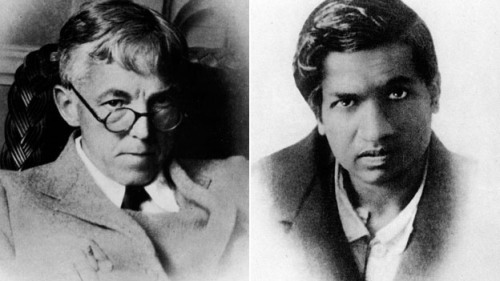
Related image

In lectures, his enthusiasm and delight in the subject fairly spilled over. “One felt,” wrote one of his later students, E. C. Titchmarsh, “that nothing else in the world but the proof of these theorems really mattered.” Norbert Wiener, the American mathematical prodigy who would later create the field known as “cybernetics,” attended Hardy’s lectures. “In all my years of listening to lectures in mathematics,” he would write, “I have never heard the equal of Hardy for clarity, for interest, or for intellectual power.” Around this time, a pupil of E. W. Barnes, director of mathematical studies at Trinity, sought Barnes’s advice about what lectures to attend. Go to Hardy’s, he recommended. The pupil hesitated. “Well,” replied Barnes, “you need not go to Hardy’s lectures if you don’t want, but you will regret it—as indeed,” recalled the pupil many years later, “I have.” Others who missed his lectures may not, in retrospect, have felt such regret: so great was Hardy’s personal magnetism and enthusiasm, it was said, that he sometimes diverted to mathematics those without the necessary ability and temperament.

But as lucid as were his lectures, it was his writing that probably had more impact. Later, speculating about what career he might have chosen other than mathematics, Hardy noted that “Journalism is the only profession, outside academic life, in which I should have felt really confident of my chances.” Indeed, no field demanding literary craftsmanship could fail to have profited from his attention. “He wrote, in his own clear and unadorned fashion, some of the most perfect English of his time,” C. P. Snow once said of him. That Hardy’s impressions of Ramanujan would be so relentlessly quoted, and would go so far toward fixing Ramanujan’s place in history, owes not alone to his close relationship with Ramanujan but to the sheer grace with which he wrote about him.

**

Thought, Hardy used to say, was for him impossible without words. The very act of writing out his lecture notes and mathematical papers gave him pleasure, merged his aesthetic and purely intellectual sides. Why, if you didn’t know math was supposed to be dry and cold, and had only a page from one of his manuscripts to go on, you might think you’d stumbled on a specimen of some new art form beholden to Chinese calligraphy. Here were inequality symbols that slashed across the page, sweeping integral signs an inch and a quarter high, sigmas that resonated like the key signatures on a musical staff. There was a spaciousness about how he wrote out mathematics, a lightness, as if rejecting the cramped, ungenerous formalities of the printed notation. He was like a French impressionist, intimating worlds with a few splashes of color, not a maker of austere English miniatures.

Thursday, February 28, 2019

Lack of Paper


“Once, the story goes, a friend found him around the docks during working hours, prowling for packing paper on which to work calculations. Another time, Sir Francis called Narayana Iyer into his office. How, he demanded to know, sternly regarding his aide, had these pages of mathematical results gotten mixed into this important file? Was he, perhaps, using office time to dabble in mathematics? Narayana Iyer pleaded innocent, claimed the math wasn’t in his handwriting at all, that perhaps it was Ramanujan’s work. Sir Francis laughed. Of course it was Ramanujan’s work. He’d known as much all along.”

Saturday, February 23, 2019

Ramanujan


A thousand years before the British came, Indians were doing mathematics. Before the seventh century, while the West was still mired in awkward Roman numerals, India had introduced the numerals we use today. The zero, a symbol expressing nothingness, represented a particular triumph; it may go back to as early as the second century B.C. but definitely appeared in a book in the third century and on the wall of a temple near Gwalior, in central India, in the ninth (where it helped specify a flower garden as 270 units long).

Many of India’s contributions to mathematics were spurred by the need to know, based on astronomical factors, the correct times for Vedic ceremonies. Algebra, geometry, and trigonometry were all thereby enriched. Figures like Aryabhata, born in A.D. 476, who established one of the earliest and best values for π, and Brahmagupta, 150 years later, left theorems even now associated with their names.

It was a rich tradition, but one quite different from that of Greece, the cradle of Western mathematics. Whereas the Greeks, especially Euclid, emphasized formal proof, as in the step-by-step process high school students first encounter in geometry, Indian mathematics stressed the results themselves, however obtained. And without that winnowing out of mathematical dross that formal proof achieved, Indian mathematics was wildly uneven; some of it was just plain wrong. One Muslim writer noted in a book about India that Hindu mathematics was “a mixture of pearl shells and sour dates . . . of costly crystal and common pebbles.”

“By the twentieth century, the pearl shells and crystal had long lain buried in the dust of time. For centuries, India had stood its mathematical ground against the rest of the world. But now, that was ancient history; of late it had added little to the world’s mathematical treasure. Only a line of brilliant mathematicians in Kerala, on the subcontinent’s southwest tip, broke the gloom that otherwise extended back to the great Bhaskara of the twelfth century. The birth of the Mathematical Society could not ensure a rebirth. But its founders—hungry to connect with the West, proud of their country’s heritage yet soberly aware that reverence for the past was no substitute for present achievement—surely hoped it did.

It was into this nascent new world that Ramanujan “came out,” as it were, as a mathematician in 1911.”

Saturday, January 26, 2019

“An equation has no meaning unless it expresses a thought of God”


“In the West, there was an old debate as to whether mathematical reality was made by mathematicians or, existing independently, was merely discovered by them. Ramanujan was squarely in the latter camp; for him, numbers and their mathematical relationships fairly threw off clues to how the universe fit together. Each new theorem was one more piece of the Infinite unfathomed. So he wasn’t being silly, or sly, or cute when later he told a friend, “An equation for me has no meaning unless it expresses a thought of God.”

Ramanujan's Notebooks


“The first of the published Notebooks that come down to us today, which Ramanujan may have prepared around the time he left Pachaiyappa’s College in 1907, was written in what someone later called “a peculiar green ink,” its more than two hundred large pages stuffed with formulas on hypergeometric series, continued fractions, singular moduli . . .

But this “first” notebook, which was later expanded and revised into a second, is much more than mere odd notes. Broken into discrete chapters devoted to particular topics, its theorems numbered consecutively, it suggests Ramanujan looking back on what he has done and prettying it up for formal presentation, perhaps to help him find a job. It is, in other words, edited. It contains few outright errors; mostly, Ramanujan caught them earlier. And most of its contents, arrayed across fifteen or twenty lines per page, are entirely legible; one needn’t squint to make out what they say. No, this is no impromptu record, no pile of sketches or snapshots; rather, it is like a museum retrospective, the viewer being guided through well-marked galleries lined with the artist’s work.

Or so they were intended. At first, Ramanujan proceeded methodically, in neatly organized chapters, writing only on the right-hand side of the page. But ultimately, it seems, his resolve broke down. He began to use the reverse sides of some pages for scratch work, or for results he’d not yet categorized.

“Mathematical jottings piled up, now in a more impetuous hand, with some of it struck out, and sometimes with script marching up and down the page rather than across it. One can imagine Ramanujan vowing that, yes, this time he is going to keep his notebook pristine . . . when, working on an idea and finding neither scratch paper nor slate at hand, he abruptly reaches for the notebook with its beckoning blank sheets—the result coming down to us today as flurries of thought transmuted into paper and ink.

In those flurries, we can imagine the very earliest notebooks, those predating the published ones, coming into being. Ramanujan had set out to prove the theorems in Carr’s book but soon left his remote mentor behind. Experimenting, he saw new theorems, went where Carr had never—or, in many cases, no one had ever—gone before. At some point, as his mind daily spun off new theorems, he thought to record them. Only over the course of years, and subsequent editions, did those early, haphazard scribblings evolve into the published Notebooks that today sustain a veritable cottage industry of mathematicians devoted to their study.”

**
“Two monkeys having robbed an orchard of 3 times as many plantains as guavas, are about to begin their feast when they espy the injured owner of the fruits stealthily approaching with a stick. They calculate that it will take him 2 1/4 minutes to reach them. One monkey who can eat 10 guavas per minute finishes them in 2/3 of the time, and then helps the other to eat the plantains. They just finish in time. If the first monkey eats plantains twice as fast as guavas, how fast can the second monkey eat plantains?”

This charming little problem had appeared some years before Ramanujan’s time in an Indian mathematical textbook. Exotic as it might seem at first, one has but to change the monkeys to foxes, and the guavas to grapes, to recognize one of those exercises, beloved of some educators, supposed to inject life and color into mathematics’ presumably airless tracts. Needless to say, this sort of trifle, however tricky to solve, bears no kinship to the brand of mathematics that filled Ramanujan’s notebooks.

Ramanujan needed no vision of monkeys chomping on guavas to spur his interest. For him, it wasn’t what his equation stood for that mattered, but the equation itself, as pattern and form. And his pleasure lay not in finding in it a numerical answer, but from turning it upside down and inside out, seeing in it new possibilities, playing with it as the poet does words and images, the artist color and line, the philosopher ideas.

Ramanujan’s world was one in which numbers had properties built into them. Chemistry students learn the properties of the various elements, the positions in the periodic table they occupy, the classes to which they belong, and just how their chemical properties arise from their atomic structure. Numbers, too, have properties which place them in distinct classes and categories.

For starters, there are even numbers, like 2, 4, and 6; and odd numbers, like 1, 3, and 5.

There are the integers—whole numbers, like 2, 3, and 17; and nonintegers, like 17 1/4 and 3.778.

Numbers like 4, 9, 16, and 25 are the product of multiplying the integers 2, 3, 4, and 5 by themselves; they are “squares,” whereas 3, 10, and 24, for example, are not.

A 6 differs fundamentally from a 5, in that you can get it by multiplying two other numbers, 2 and 3; whereas a 5 is the product only of itself and 1. Mathematicians call 5 and numbers like it (2, 3, 7, and 11, but not 9) “prime.” Meanwhile, 6 and other numbers built up from primes are termed “composite.”


That happens often in mathematics; a notion at first glance arbitrary, or trivial, or paradoxical turns out to be mathematically profound, or even of practical value. After an innocent childhood of ordinary numbers like 1, 2, and 7, one’s initial exposure to negative numbers, like − 1 or − 11, can be unsettling. Here, it doesn’t require much arm-twisting to accept the idea: If t represents a temperature rise, but the temperature drops 6 degrees, you certainly couldn’t assign the same t = 6 that you would for an equivalent temperature rise; some other number, − 6, seems demanded. Somewhat analogously, imaginary numbers—as well as many other seemingly arbitrary or downright bizarre mathematical concepts—turn out to make solid sense.

Ramanujan’s notebooks ranged over vast terrain. But this terrain was virtually all “pure” mathematics. Whatever use to which it might one day be put, Ramanujan gave no thought to its practical applications. He might have laughed out loud over the monkey and the guava problem, but he thought not at all, it is safe to say, about raising the yield of South Indian rice. Or improving the water system. Or even making an impact on theoretical physics; that, too, was “applied.”

Rather, he did it just to do it. Ramanujan was an artist. And numbers—and the mathematical language expressing their relationships—were his medium.”


Ramanujan's Failure

Image result for ramanujan
“Except for math he did poorly in all his subjects, but in physiology he reached particularly impressive lows, often scoring less than 10 percent on exams. He’d take the three-hour math exam and finish it in thirty minutes. But that got him exactly nowhere. In December 1906, he appeared again for the F.A. examination and failed. The following year, he took it again. And failed again.

Government College, Kumbakonam, 1904 and 1905 . . . Pachaiyappa’s College, Madras, 1906 and 1907 . . . In the first decade of the twentieth century, there was no room for Srinivasa Ramanujan in the higher education system of South India. He was gifted, and everyone knew it. But that hardly sufficed to keep him in school or get him a degree.

The System wouldn’t budge.

**

“To bring in money, Ramanujan approached friends of the family; perhaps they had accounts to post, or books to reconcile? Or a son to tutor? One student, for seven rupees a month, was Viswanatha Sastri, son of a Government College philosophy professor. Early each morning, Ramanujan would walk to the boy’s house on Solaiappa Mudali Street, at the other end of town, to coach him in algebra, geometry, and trigonometry. The only trouble was, he couldn’t stick to the course material. He’d teach the standard method today and then, if Viswanatha forgot it, would improvise a wholly new one tomorrow. Soon he’d be lost in areas the boy’s regular teacher never touched.

Sometimes he would fly off onto philosophical tangents. They’d be discussing the height of a wall, perhaps for a trigonometry problem, and Ramanujan would insist that its height was, of course, only relative: who could say how high it seemed to an ant or a buffalo? One time he asked how the world would look when first created, before there was anyone to view it. He took delight, too, in posing sly little problems: If you take a belt, he asked Viswanatha and his father, and cinch it tight around the earth’s twenty-five-thousand-mile-long equator, then let it out just 2π feet—about two yards—how far off the earth’s surface would it stand? Some tiny fraction of an inch? Nope, one foot.”

“Viswanatha Sastri found Ramanujan inspiring; other students, however, did not. One classmate from high school, N. Govindaraja Iyengar, asked Ramanujan to help him with differential calculus for his B.A. exam. The arrangement lasted all of two weeks. You can think of calculus as a set of powerful mathematical tools; that’s how most students learn it and what most exams require. Or else you can appreciate it for the subtle questions it poses about the nature of the infinitesimally small and the infinitely large. Ramanujan, either unmindful of his students’ practical needs or unwilling to cater to them, stressed the latter. “He would talk only of infinity and infinitesimals,” wrote Govindaraja, who was no slouch intellectually and wound up as chairman of India’s public service commission. “I felt that his tuition [teaching] might not be of real use to me in the examination, and so I gave it up.”

Ramanujan had lost all his scholarships. He had failed in school. Even as a tutor of the subject he loved most, he’d been found wanting.

He had nothing.

And yet, viewed a little differently, he had everything. For now there was nothing to distract him from his notebooks—notebooks, crammed with theorems, that each day, each week, bulged wider.”

Thursday, October 4, 2018

Ramanujan's Monologues

Illustration: R Rajesh


When he was twenty-one, he showed up at the house of a teacher, got drawn into conversation, and soon was expatiating on the ties he saw between God, zero, and infinity—keeping everyone spellbound till two in the morning. It was that way often for Ramanujan. Losing himself in philosophical and mystical monologues, he’d make bizarre, fanciful leaps of the imagination that his friends did not understand but found fascinating anyway. So absorbed would they become that later all they could recall was the penetrating set of his eyes.


**

It had been Namagiri to whom Ramanujan’s mother and father, childless for some years after they married, had prayed for a child. Ramanujan’s maternal grandmother, Rangammal, was a devotee of Namagiri and was said to enter a trance to speak to her. One time, a vision of Namagiri warned her of a bizarre murder plot involving teachers at the local school. Another time, many years earlier, before Ramanujan’s birth, Namagiri revealed to her that the goddess would one day speak through her daughter’s son. Ramanujan grew up hearing this story. And he, too, would utter Namagiri’s name all his life, invoke her blessings, seek her counsel. It was goddess Namagiri, he would tell friends, to whom he owed his mathematical gifts. Namagiri would write the equations on his tongue. Namagiri would bestow mathematical insights in his dreams.
So he told his friends. Did he believe it?
His grandmother did, and so did his mother.

The Off-Scale Student

http://www.indiaart.com/Art-Marketplace/painting-details/19977/Ramanujan

“Ramanujan’s family, always strapped for cash, often took in boarders. Around the time he was eleven, there were two of them, Brahmin boys, one from the neighboring district of Trichinopoly, one from Tirunelveli far to the south, studying at the nearby Government College. Noticing Ramanujan’s interest in mathematics, they fed it with whatever they knew. Within months he had exhausted their knowledge and was pestering them for math texts from the college library. Among those they brought to him was an 1893 English textbook popular in South Indian colleges and English preparatory schools, S. L. Loney’s Trigonometry, which actually ranged into more advanced realms. By the time Ramanujan was thirteen, he had mastered it.

Ramanujan learned from an older boy how to solve cubic equations. He came to understand trigonometric functions not as the ratios of the sides in a right triangle, as usually taught in school, but as far more sophisticated concepts involving infinite series. He’d rattle off the numerical values of π and e, “transcendental” numbers appearing frequently in higher mathematics, to any number of decimal places. He’d take exams and finish in half the allotted time. Classmates two years ahead would hand him problems they thought difficult, only to watch him solve them at a glance.

Occasionally, his powers were put to good use. Some twelve hundred students attended the school and each had to be assigned to classrooms, and to the school’s three dozen or so teachers, while satisfying any special circumstances peculiar to particular students. At Town High, the senior math teacher, Ganapathi Subbier, was regularly shackled with the maddening job—and he would give it to Ramanujan.

By the time he was fourteen and in the fourth form, some of his classmates had begun to write Ramanujan off as someone off in the clouds with “whom they could scarcely hope to communicate. “We, including teachers, rarely understood him, remembered one of his contemporaries half a century later. Some of his teachers may already have felt uncomfortable in the face of his powers. But most of the school apparently stood in something like respectful awe of him, whether they knew what he was talking about or not.

He became something of a minor celebrity. All through his school years, he walked off with merit certificates and volumes of English poetry as scholastic prizes. Finally, at a ceremony in 1904, when Ramanujan was being awarded the K. Ranganatha Rao prize for mathematics, headmaster Krishnaswami Iyer introduced him to the audience as a student who, were it possible, deserved higher than the maximum possible marks.

An A-plus, or 100 percent, wouldn’t do to rate him. Ramanujan, he was saying, was off-scale.”

Friday, September 28, 2018

Locked Away Ramanujans


It is a story of one man and his stubborn faith in his own abilities. But it is not a story that concludes, Genius will out—though Ramanujan’s, in the main, did. Because so nearly did events turn out otherwise that we need no imagination to see how the least bit less persistence, or the least bit less luck, might have consigned him to obscurity. In a way, then, this is also a story about social and educational systems, and about how they matter, and how they can sometimes nurture talent and sometimes crush it. How many Ramanujans, his life begs us to ask, dwell in India today, unknown and unrecognized? And how many in America and Britain, locked away in racial or economic ghettos, scarcely aware of worlds outside their own?

Saturday, November 11, 2017

After Mirzakhani


Complicating the global image of a nation

Much of the reactions to the death of Mirzakhani was both normal and predictable. The Iranian President Hassan Rouhani and the Stanford University President Marc Tessier-Lavigne both issued solemn statements of condolences. The Iranian media competed in showering her with accolades. The Iranian oppositional venues in the United States and Europe began to use and abuse the occasion to denounce the Islamic Republic for its various policies, especially for the conditions conducive to "brain drain".


Maryam Mirzakhani left Iran to pursue her advanced mathematical studies in the US. She would have gone to Baghdad to do so if she were born one thousand years ago - and she would have probably gone to Beijing if she were born just a couple of decades from now. The question of "brain drain" is, of course, a serious malady in Iran and many other similar countries. But Maryam Mirzakhani was no "brain drain". Hers was a superior intelligence and she travelled where she could nourish it best - and that travelling did not suddenly turn her into this strange thing called "Iran-born", instead of just plain "Iranian".


But something else, something quite simple and significant, was also happening, just like Maryam Mirzakhani herself, gently and quietly.


Mirzakhani is comparable to Omar Khayyam not just because they were both Iranian mathematicians. But because like Khayyam, Mirzakhani too complicates the vision of their common homelands in the European and now American imagination in unpredictable ways.


Markedly brilliant minds and beautiful souls like Maryam Mirzakhani both upon their global recognitions and perforce upon their early and tragic passing become a symbol, a sign, a citation far beyond who they are and what they have achieved in their professional calling. From the time that she achieved her coveted Fields Medal, Maryam Mirzakhani had begun to complicate the global image of her homeland against the backdrop of the pervasive demonisation of Iran by one brand of warmongering or another.


Nations need to be simplified to be targeted for military strikes. Afghanistan was reduced to Mullah Omar. Iraq was reduced to Saddam Hussein. The more the image of a nation is complicated the more difficult it is for warmongers in Washington, Tel Aviv, or Riyadh targeting it for destruction.


Precisely in the quiet dignity of her work, her avoiding publicity like a plague, the tiny, cancer-ravaged body of Maryam Mirzakhani shined like a beautiful star on the dark planet of her earthly life. An Iranian, a Muslim, a woman of modest middle-class background, rising gloriously to put a big brilliant question mark in front of everything mobilised against her people!


Those exonerating Iranian people when targeting "Iran" for demonisation should take a look at what they have done to Afghanistan, Iraq, Syria, or Libya before they might believe their own delusions. Ordinary people, not governments, are the primary targets and the final victims of warmongering anywhere and everywhere.


To be sure, much to the chagrin of warmongers, the image of Iran has been complicated by other prominent Iranians, in particular, those who have put Iranian cinema on the global map. I recall vividly when another accomplished Iranian young woman, Samira Makhmalbaf first appeared in Cannes Film Festival at the age of seventeen to premier her film "Apple" in 1998. She too succeeded that year, seriously altering the image of Iran from that of a bearded angry man to a gifted young woman.
 
In the realm of art, no one, of course, did more to complicate the image of Iran than the late master Abbas Kiarostami who was the principal engine bringing the rest of Iranian art to global spotlight.


But much of that complexity has been in the realm of arts, not sciences. In the realm of science, the only thing publicly related to Iran is, of course, the nuclear scientists who are the targets of assassinations presumably by a settler colony on planet Mars that is very concerned about the Iranian nuclear programme. These Martians are suspected to have occasionally sent their assassins to kill these Iranian nuclear scientists.


Mirzakhani was not a nuclear physicist. A breed apart, she was a world-renowned mathematician. Her accomplishments, as a result, assume entirely historical proportions comparable to other Iranian and Muslim scientists at the historical level of Muhammad ibn Musa al-Khwarizmi, Muhammad ibn Zakariyya al-Razi, and above all to Omar Khayyam, the towering astronomer and mathematician.


Mirzakhani's uplifting of her homeland to its historical memories alerts the world to a whole different register of consciousness about Iran as a Muslim a country in circumstances that, because of pervasive Islamophobia in the US, even Rumi is read as if he were a New Age guru from California.


Mirzakhani is comparable to Omar Khayyam not just because they were both Iranian mathematicians. But because like Khayyam, Mirzakhani too complicates the vision of their common homeland in the European and now American imagination in unpredictable ways.
The reputation of Omar Khayyam as a poet, however, widely outshines his fame as a mathematician. But the difference is only on the surface. The beauty of Khayyam's mathematical mind, it now seems, had to be translated, as it were, into poetic scepticism to be registered for mortal beings, whereas Maryam Mirzakhani's poetry was and remained in pure mathematics.


**
The mathematician, poet, painter


On another occasion, she said: "Of course, the most rewarding part is the 'Aha' moment, the excitement of discovery and enjoyment of understanding something new - the feeling of being on top of a hill and having a clear view. But most of the time, doing mathematics for me is like being on a long hike with no trail and no end in sight". That is the mind of a mathematician in the soul of a poet. That is Khayyam incarnate.


Mirzakhani's mathematical equations were her poetry - a poetry only a happy few can decipher to their delight. The world at large is baffled at the beauty of that poetry. Thus, the other more recent kindred soul of Mirzakhani was, of course, the Indian mathematician Srinivasa Ramanujan (1887-1920) who died even younger than her.


The famous story narrated by Ramanujan's English colleague, the prominent mathematician GH Hardy, is now known as "Hardy-Ramanujan number 1729". According to Hardy, he was once going to see Ramanujan when he was bedridden. Hardy had just ridden in a cab number 1729 and upon arrival, he remarked to his friend that the number seemed to be quite dull and that he hoped it was not an unfavourable omen. "No", Ramanujan replied: "It is a very interesting number. It is the smallest number expressible as the sum of two cubes in two different ways". The two different ways are:


1729 = 13+123 = 93+103.


Now, that is pure poetry - for what is poetry other than a truth so obviously beautiful that mortals cannot see it. The joyous eyes of Maryam Mirzakhani's little daughter could see what her mother's beautiful mind knew with mathematical precision: "At the family's home, near Stanford University," Roberts tells us in her essay on the Iranian mathematician, "Mirzakhani would spend hours on the floor with supersized canvases of paper, sketching out ideas, drawing diagrams and formulae, often leading Anahita, now six, to exclaim, 'Oh, Mommy is painting again!"


Hamid Dabashi

aljazeera 

Saturday, September 26, 2015

Matematik Bir Gençlik Oyunudur

                                                      Evariste Galois
Bir matematikçi şunu aklından çıkarmamalıdır ki matematik, herhangi bir sanat veya bilim dalında olduğundan daha çok, bir gençlik oyunudur. Nispeten basit bir örnek vermek gerekirse, Royal Society'e seçilen matematikçiler, yaş ortalaması en düşük grubu oluştururlar.

Kuşkusuz daha çarpıcı örnekler de bulabiliriz. Dünyanın en büyük üç matematikçisinden biri olduğu kesin olan birisinin meslek hayatını ele alalım. Newton matematiği elli yaşında bıraktı; ilgisini ise çok daha önce yitirmişti. Kırk yaşına geldiğinde, parlak yaratıcılık günlerinin artık geride kaldığını şüphesiz farketmişti. Bilime en önemli katkıları olan değişme hızı (fluxions) ve yerçekimi kanununu 1666’da, yirmi dört yaşındayken geliştirmişti: "O zamanlar yeni buluşlar için en olgun çağımdaydım; matematik ve felsefe konularına daha sonra hiçbir zaman aynı ilgiyi duymadım." Newton neredeyse kırk yaşına kadar büyük buluşlar yaptı ("eliptik yörünge"yi 37 yaşında keşfetti); fakat sonraları, daha önceki çalışmalarını tamamlamak ve geliştirmek dışında pek az şey yaptı.

Galois yirmi bir, Abel yirmi yedi, Ramanujan otuz üç, Riemann kırk yaşında öldü. Çok daha ileri yaşlarda büyük işler başarmış insanlar vardır; Gauss'un diferansiyel geometri konusundaki ünlü incelemesi elli yaşında iken basılmıştı (ancak ana fikirler on yıl öncesinde olmuştu). 
Matematik alanında, elli yaşını geçmiş kimseler tarafından önemli bir katkıda bulunulduğunu hatırlamıyorum. Olgun yaşta bir kimse eğer ilgisini yitirip matematik çalışmalarını bırakmışsa bu ne kendisi için ne de matematik için, pek de ciddi bir kayıp olmayabilir.