Showing posts with label Christopher Columbus. Show all posts

Monday, September 6, 2021

October 12, 1492: Genocide not discovery


Roxanne Durban-Ortiz, Lithub

Mahmood Mamdani, in Neither Settler nor Native, locates the founding moment of the modern nation-state at 1492, noting it emerged out of two developments in Iberia. “One was ethnic cleansing, whereby the Castilian monarchy sought to create a homogeneous national homeland for Christian Spaniards by ejecting and converting those among them who were strangers to the nation—Moors and Jews. The other development was the taking of overseas colonies in the Americas by the same Castilian monarchy that spearheaded ethnic cleansing.” Mamdani emphasizes that modern colonialism didn’t suddenly start occurring in the 18th century but that European colonialism and the modern state were co-constituted.

*

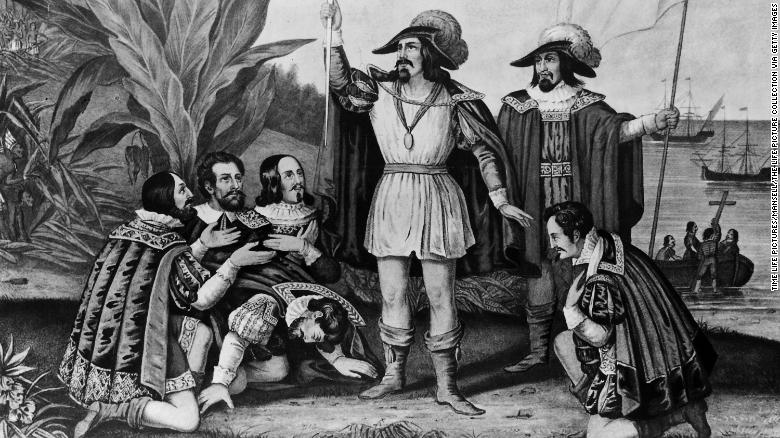
A few months after Catholic entry into ethnically cleansed Granada, the Spanish monarchs contracted with a Genoese seaman who promised he could reach India by a shorter route by sailing west. Columbus landed not at already European “discovered” India but, rather, on an island of what is now called the Bahamas. The thriving Indigenous residents informed him that to the north and south and east and west stretched a huge landmass, two massive continents teeming with cities and tens of millions of acres of farmlands that would come to constitute the major portion of humanity’s food production. The rapacious crusade-hardened mercenaries representing Christendom were skeptical, until some voyages later they reached the continent at Central America, which they named Cabo Gracias a Díos (Thanks to God Cape). Two decades later a Spanish army would possess the heart of that landmass, destroying the most populated city in the world at the time, Tenochtitlán, in the valley of México.

October 12, 1492, is etched in the brains of many as the day of “discovery,” but the Indigenous peoples of the Western Hemisphere and of Africa and descendants of enslaved Africans regard the date as the symbol of infamy, domination, slavery, and genocide. Haitian historian Michel-Rolph Trouillot writes, “To call ‘discovery’ the first invasions of inhabited lands by Europeans is an exercise in Eurocentric power that already frames future narratives of the event so described Once discovered by Europeans, the Other finally enters the human world.”


Saturday, November 24, 2018

Plants from South America


Columbus is, of course, a person who has inspired admiration and vilification in almost equal measures. He forged a connection which would see the empires of Europe rising to become global superpowers, while the Eden of the Americas was plundered and its civilisations destroyed. Setting foot on that beach, he sealed the fate of tens of millions of Native Americans and ten million Africans. The impact of that moment would ripple out through history. Until this point, Europe had been something of a backwater – but the establishment of colonies in the New World would change all that. The rise of the West had begun.

And the impact would be felt not just throughout human societies, around the world, but by the species that had become our allies – on both sides of the Atlantic. This contact between Europe and the Americas would quickly turn into a sustained connection between the Old and New Worlds. These supercontinents had been largely separate since the break-up of Pangaea, which began around 150 million years ago. During the Great Ice Age, the Pleistocene, the world went through repeated glaciations. And during the glacial periods, sea levels would fall to such an extent that the north-east tip of Asia would be joined to the north-west corner of North America, via a tract of land known as Beringia – or the ‘Bering land bridge’. This bridge
would allow some interchange of plants and animals between Asia and North America. It was the route by which humans first colonised the Americas, around 17,000 years ago. And yet the ancient, underlying theme of divergence and difference between the flora and fauna of the Old and New Worlds persisted – until the human-mediated transfer of plants and animals which started with Columbus bringing back his pineapples, chilli and tobacco in 1492. Plants and animals which had been contained and separate from each other made that leap across the pond, to find themselves facing new landscapes, new challenges and new opportunities on the opposite side. Cattle and coffee, sheep and sugar cane, chickens and chickpeas, wheat and rye travelled from the Old World to the New. Turkeys and tomatoes, pumpkins and potatoes, Muscovy duck and maize made the reverse journey.

The Columbian Exchange has been described by some as the most significant ecological event on the planet since the dinosaurs were wiped out. It was the beginning of globalisation: the world became not just interconnected but interdependent. But it had a wretched inception.

The fortunes of Europe (and, in due course, Asia and Africa) were transformed by the domesticated species brought back from the New World. Novel crops boosted agriculture and populations began to recover from war, famine and plague. But that was in the Old World. In the Americas, a scene of devastation ensued. Just as plants and animals had followed separate evolutionary trajectories on either side of the Atlantic, the pace and direction of technological change had been different in the Old World compared with the New. The Europeans possessed advanced technology: their military and maritime kit was vastly superior to that of the Native Americans. The immediate consequences of contact, with heart-stopping, dreadful inevitability, were tragic. Disease organisms were also part of that Columbian Exchange: the Europeans brought back syphilis from the Americas, while introducing smallpox there – with disastrous consequences. The indigenous population of the Americas plummeted after conquest. It was decimated: by the middle of the seventeenth century, 90 per cent of the indigenous population had been wiped out.

It’s easy to focus on the power imbalance that existed between the Old and New Worlds in the fifteenth and sixteenth centuries. Human societies had developed in different ways in the Americas and in Europe, but it wasn’t as though the Native Americans were entirely without technology – far from it. When it came to their exploitation of natural resources, they were clearly experts. It’s wrong to see the pre-Columbian Americas as, on the one hand, a natural Garden of Eden, and on the other, an innovation vacuum in need of European inspiration to realise its potential. Native American societies had a rich and diverse history of innovation, and the Americas contained completely independent centres of domestication. Many of the pre-Columbian societies of the Americas were large, urbanised – and already dependent on agriculture.
The Spanish explorers didn’t pluck wild plants, out of relative obscurity, recognise their utility for the first time, and transform them into something which would greatly benefit humanity. What the Europeans found on the other side of the Atlantic were organisms which had already changed away from wildness, over thousands of years – which had already entered into a tightly bound, successful alliance with humans. What Columbus discovered was not only a new land, previously unknown to Europeans, but a wealth of useful, tamed animals and plants – ready-made domesticates.

Among those prizes was that cereal he’d spotted and written about, just four days after landing on San Salvador – the cereal that was not only a staple food but a sacred food for the Aztecs and Incas, whose civilisations would soon be swallowed up by the Spanish Empire: maize.

Friday, August 25, 2017

America's Population Before Columbus


On May 30, 1539, Hernando de Soto landed his private army near Tampa Bay, in Florida. Soto, as he was called, was a novel figure: half warrior, half venture capitalist. He had grown very rich very young by becoming a market leader in the nascent trade for Indian slaves. The profits had helped to fund Pizarro's seizure of the Incan empire, which had made Soto wealthier still. Looking quite literally for new worlds to conquer, he persuaded the Spanish Crown to let him loose in North America. He spent one fortune to make another. He came to Florida with 200 horses, 600 soldiers, and 300 pigs.


From today's perspective, it is difficult to imagine the ethical system that would justify Soto's actions. For four years his force, looking for gold, wandered through what is now Florida, Georgia, North and South Carolina, Tennessee, Alabama, Mississippi, Arkansas, and Texas, wrecking almost everything it touched. The inhabitants often fought back vigorously, but they had never before encountered an army with horses and guns. Soto died of fever with his expedition in ruins; along the way his men had managed to rape, torture, enslave, and kill countless Indians. But the worst thing the Spaniards did, some researchers say, was entirely without malice—bring the pigs.


According to Charles Hudson, an anthropologist at the University of Georgia who spent fifteen years reconstructing the path of the expedition, Soto crossed the Mississippi a few miles downstream from the present site of Memphis. It was a nervous passage: the Spaniards were watched by several thousand Indian warriors. Utterly without fear, Soto brushed past the Indian force into what is now eastern Arkansas, through thickly settled land—"very well peopled with large towns," one of his men later recalled, "two or three of which were to be seen from one town." Eventually the Spaniards approached a cluster of small cities, each protected by earthen walls, sizeable moats, and deadeye archers. In his usual fashion, Soto brazenly marched in, stole food, and marched out.


After Soto left, no Europeans visited this part of the Mississippi Valley for more than a century. Early in 1682 whites appeared again, this time Frenchmen in canoes. One of them was Réné-Robert Cavelier, Sieur de la Salle. The French passed through the area where Soto had found cities cheek by jowl. It was deserted—La Salle didn't see an Indian village for 200 miles. About fifty settlements existed in this strip of the Mississippi when Soto showed up, according to Anne Ramenofsky, an anthropologist at the University of New Mexico. By La Salle's time the number had shrunk to perhaps ten, some probably inhabited by recent immigrants. Soto "had a privileged glimpse" of an Indian world, Hudson says. "The window opened and slammed shut. When the French came in and the record opened up again, it was a transformed reality. A civilization crumbled. The question is, how did this happen?"


The question is even more complex than it may seem. Disaster of this magnitude suggests epidemic disease. In the view of Ramenofsky and Patricia Galloway, an anthropologist at the University of Texas, the source of the contagion was very likely not Soto's army but its ambulatory meat locker: his 300 pigs. Soto's force itself was too small to be an effective biological weapon. Sicknesses like measles and smallpox would have burned through his 600 soldiers long before they reached the Mississippi. But the same would not have held true for the pigs, which multiplied rapidly and were able to transmit their diseases to wildlife in the surrounding forest. When human beings and domesticated animals live close together, they trade microbes with abandon. Over time mutation spawns new diseases: avian influenza becomes human influenza, bovine rinderpest becomes measles. Unlike Europeans, Indians did not live in close quarters with animals—they domesticated only the dog, the llama, the alpaca, the guinea pig, and, here and there, the turkey and the Muscovy duck. In some ways this is not surprising: the New World had fewer animal candidates for taming than the Old. Moreover, few Indians carry the gene that permits adults to digest lactose, a form of sugar abundant in milk. Non-milk-drinkers, one imagines, would be less likely to work at domesticating milk-giving animals. But this is guesswork. The fact is that what scientists call zoonotic disease was little known in the Americas. Swine alone can disseminate anthrax, brucellosis, leptospirosis, taeniasis, trichinosis, and tuberculosis. Pigs breed exuberantly and can transmit diseases to deer and turkeys. Only a few of Soto's pigs would have had to wander off to infect the forest.


Indeed, the calamity wrought by Soto apparently extended across the whole Southeast. The Coosa city-states, in western Georgia, and the Caddoan-speaking civilization, centered on the Texas-Arkansas border, disintegrated soon after Soto appeared. The Caddo had had a taste for monumental architecture: public plazas, ceremonial platforms, mausoleums. After Soto's army left, notes Timothy K. Perttula, an archaeological consultant in Austin, Texas, the Caddo stopped building community centers and began digging community cemeteries. Between Soto's and La Salle's visits, Perttula believes, the Caddoan population fell from about 200,000 to about 8,500—a drop of nearly 96 percent.


In the eighteenth century the tally shrank further, to 1,400. An equivalent loss today in the population of New York City would reduce it to 56,000—not enough to fill Yankee Stadium. "That's one reason whites think of Indians as nomadic hunters," says Russell Thornton, an anthropologist at the University of California at Los Angeles. "Everything else—all the heavily populated urbanized societies—was wiped out."


Could a few pigs truly wreak this much destruction? Such apocalyptic scenarios invite skepticism. As a rule, viruses, microbes, and parasites are rarely lethal on so wide a scale—a pest that wipes out its host species does not have a bright evolutionary future. In its worst outbreak, from 1347 to 1351, the European Black Death claimed only a third of its victims. (The rest survived, though they were often disfigured or crippled by its effects.) The Indians in Soto's path, if Dobyns, Ramenofsky, and Perttula are correct, endured losses that were incomprehensibly greater.


One reason is that Indians were fresh territory for many plagues, not just one. Smallpox, typhoid, bubonic plague, influenza, mumps, measles, whooping cough—all rained down on the Americas in the century after Columbus. (Cholera, malaria, and scarlet fever came later.) Having little experience with epidemic diseases, Indians had no knowledge of how to combat them. In contrast, Europeans were well versed in the brutal logic of quarantine. They boarded up houses in which plague appeared and fled to the countryside. In Indian New England, Neal Salisbury, a historian at Smith College, wrote in Manitou and Providence (1982), family and friends gathered with the shaman at the sufferer's bedside to wait out the illness—a practice that "could only have served to spread the disease more rapidly."


**
Human history, in Crosby's interpretation, is marked by two world-altering centers of invention: the Middle East and central Mexico, where Indian groups independently created nearly all of the Neolithic innovations, writing included. The Neolithic Revolution began in the Middle East about 10,000 years ago. In the next few millennia humankind invented the wheel, the metal tool, and agriculture. The Sumerians eventually put these inventions together, added writing, and became the world's first civilization. Afterward Sumeria's heirs in Europe and Asia frantically copied one another's happiest discoveries; innovations ricocheted from one corner of Eurasia to another, stimulating technological progress. Native Americans, who had crossed to Alaska before Sumeria, missed out on the bounty. "They had to do everything on their own," Crosby says. Remarkably, they succeeded.


When Columbus appeared in the Caribbean, the descendants of the world's two Neolithic civilizations collided, with overwhelming consequences for both. American Neolithic development occurred later than that of the Middle East, possibly because the Indians needed more time to build up the requisite population density. Without beasts of burden they could not capitalize on the wheel (for individual workers on uneven terrain skids are nearly as effective as carts for hauling), and they never developed steel. But in agriculture they handily outstripped the children of Sumeria. Every tomato in Italy, every potato in Ireland, and every hot pepper in Thailand came from this hemisphere. Worldwide, more than half the crops grown today were initially developed in the Americas.


Maize, as corn is called in the rest of the world, was a triumph with global implications. Indians developed an extraordinary number of maize varieties for different growing conditions, which meant that the crop could and did spread throughout the planet. Central and Southern Europeans became particularly dependent on it; maize was the staple of Serbia, Romania, and Moldavia by the nineteenth century. Indian crops dramatically reduced hunger, Crosby says, which led to an Old World population boom.


Along with peanuts and manioc, maize came to Africa and transformed agriculture there, too. "The probability is that the population of Africa was greatly increased because of maize and other American Indian crops," Crosby says. "Those extra people helped make the slave trade possible." Maize conquered Africa at the time when introduced diseases were leveling Indian societies. The Spanish, the Portuguese, and the British were alarmed by the death rate among Indians, because they wanted to exploit them as workers. Faced with a labor shortage, the Europeans turned their eyes to Africa. The continent's quarrelsome societies helped slave traders to siphon off millions of people. The maize-fed population boom, Crosby believes, let the awful trade continue without pumping the well dry.


Back home in the Americas, Indian agriculture long sustained some of the world's largest cities. The Aztec capital of Tenochtitlán dazzled Hernán Cortés in 1519; it was bigger than Paris, Europe's greatest metropolis. The Spaniards gawped like hayseeds at the wide streets, ornately carved buildings, and markets bright with goods from hundreds of miles away. They had never before seen a city with botanical gardens, for the excellent reason that none existed in Europe. The same novelty attended the force of a thousand men that kept the crowded streets immaculate. (Streets that weren't ankle-deep in sewage! The conquistadors had never heard of such a thing.) Central America was not the only locus of prosperity. Thousands of miles north, John Smith, of Pocahontas fame, visited Massachusetts in 1614, before it was emptied by disease, and declared that the land was "so planted with Gardens and Corne fields, and so well inhabited with a goodly, strong and well proportioned people ... [that] I would rather live here than any where."


Smith was promoting colonization, and so had reason to exaggerate. But he also knew the hunger, sickness, and oppression of European life. France—"by any standards a privileged country," according to its great historian, Fernand Braudel—experienced seven nationwide famines in the fifteenth century and thirteen in the sixteenth. Disease was hunger's constant companion. During epidemics in London the dead were heaped onto carts "like common dung" (the simile is Daniel Defoe's) and trundled through the streets. The infant death rate in London orphanages, according to one contemporary source, was 88 percent. Governments were harsh, the rule of law arbitrary. The gibbets poking up in the background of so many old paintings were, Braudel observed, "merely a realistic detail."


**
The Earth Shall Weep, James Wilson's history of Indian America, puts the comparison bluntly: "the western hemisphere was larger, richer, and more populous than Europe." Much of it was freer, too. Europeans, accustomed to the serfdom that thrived from Naples to the Baltic Sea, were puzzled and alarmed by the democratic spirit and respect for human rights in many Indian societies, especially those in North America. In theory, the sachems of New England Indian groups were absolute monarchs. In practice, the colonial leader Roger Williams wrote, "they will not conclude of ought ... unto which the people are averse."


Pre-1492 America wasn't a disease-free paradise, Dobyns says, although in his "exuberance as a writer," he told me recently, he once made that claim. Indians had ailments of their own, notably parasites, tuberculosis, and anemia. The daily grind was wearing; life-spans in America were only as long as or a little longer than those in Europe, if the evidence of indigenous graveyards is to be believed. Nor was it a political utopia—the Inca, for instance, invented refinements to totalitarian rule that would have intrigued Stalin. Inveterate practitioners of what the historian Francis Jennings described as "state terrorism practiced horrifically on a huge scale," the Inca ruled so cruelly that one can speculate that their surviving subjects might actually have been better off under Spanish rule.


I asked seven anthropologists, archaeologists, and historians if they would rather have been a typical Indian or a typical European in 1491. None was delighted by the question, because it required judging the past by the standards of today—a fallacy disparaged as "presentism" by social scientists. But every one chose to be an Indian. Some early colonists gave the same answer. Horrifying the leaders of Jamestown and Plymouth, scores of English ran off to live with the Indians.


As for the Indians, evidence suggests that they often viewed Europeans with disdain. The Hurons, a chagrined missionary reported, thought the French possessed "little intelligence in comparison to themselves." Europeans, Indians said, were physically weak, sexually untrustworthy, atrociously ugly, and just plain dirty. (Spaniards, who seldom if ever bathed, were amazed by the Aztec desire for personal cleanliness.) A Jesuit reported that the "Savages" were disgusted by handkerchiefs: "They say, we place what is unclean in a fine white piece of linen, and put it away in our pockets as something very precious, while they throw it upon the ground." The Micmac scoffed at the notion of French superiority. If Christian civilization was so wonderful, why were its inhabitants leaving?


Like people everywhere, Indians survived by cleverly exploiting their environment. Europeans tended to manage land by breaking it into fragments for farmers and herders. Indians often worked on such a grand scale that the scope of their ambition can be hard to grasp. They created small plots, as Europeans did (about 1.5 million acres of terraces still exist in the Peruvian Andes), but they also reshaped entire landscapes to suit their purposes. A principal tool was fire, used to keep down underbrush and create the open, grassy conditions favorable for game. Rather than domesticating animals for meat, Indians retooled whole ecosystems to grow bumper crops of elk, deer, and bison.


The first white settlers in Ohio found forests as open as English parks—they could drive carriages through the woods. Along the Hudson River the annual fall burning lit up the banks for miles on end; so flashy was the show that the Dutch in New Amsterdam boated upriver to goggle at the blaze like children at fireworks. In North America, Indian torches had their biggest impact on the Midwestern prairie, much or most of which was created and maintained by fire. Millennia of exuberant burning shaped the plains into vast buffalo farms. When Indian societies disintegrated, forest invaded savannah in Wisconsin, Illinois, Kansas, Nebraska, and the Texas Hill Country. Is it possible that the Indians changed the Americas more than the invading Europeans did? "The answer is probably yes for most regions for the next 250 years or so" after Columbus, William Denevan wrote, "and for some regions right up to the present time."

Source: https://www.theatlantic.com/magazine/archive/2002/03/1491/302445/

Friday, July 21, 2017

Izabel, Kolomb, Endülüs ve Engizisyon

http://www.thegreatcourses.com/courses/other-1492-ferdinand-isabella-and-the-making-of-an-empire.html

Kolomb, kararlaştırıldığı gibi Cadiz limanından değil ondan daha küçük olan Palos limanından yola çıktı, zira diğeri iğne atsan yere düşmeyecek kadar kalabalıktı. Binlerce, on binlerce Yahudi Cadiz limanı kullanılarak atalarının topraklarından atılıyorlardı.

Kolomb, Kraliçe İzabel sayesinde yolculuğunu gerçekleştirdi. Aynen Yahudiler gibi, zira onları ülkeden kovan da İzabel’di.

Katolik Krallar iki taneydi: İzabel ve Ferdinand; ancak Ferdinand iktidar işlerinden ziyade kadınlarla ve yataklarla meşguldü.

Yahudilerden sonra sıra Müslümanlara geldi.

İzabel, Müslümanların İspanya’daki son kalesini ele geçirmek için on yıl savaşmıştı. Haçlı seferi zafere ulaşıp Granada düşünce, orada yaşayan sonsuza dek cehennemde yanmaya mahkum ruhları kurtarmak için mümkün olan her şeyi yaptı. Sonsuz merhametiyle onlara affı ve din değiştirmeyi teklif etti. Şehir halkı bu teklife sopalar ve taşlarla yanıt verdi. Bu durumda İzabel ’in başka seçeneği kalmıyordu: Muhammed dininin kitaplarının yeni fethedilen şehrin büyük meydanında yakılmasını emrettikten sonra kendi yanlış dininde ve Arapça konuşmakta ısrar eden dinsizleri oradan kovdu.
Daha sonraki krallar tarafından imzalanan başka kovma kararnameleri bu temizlik operasyonunu pekiştirdi. İspanya, kanı bozuk evlatları olan Yahudileri ve Müslümanları bir daha geri dönmemek üzere sürgüne yolladı ve bunun neticesinde en iyi zanaatkârlarını, sanatçılarını, bilim adamlarını, en bilgili çiftçilerini ve en deneyimli bankacılarını ve tüccarlarını kaybetti. Buna karşılık olarak ülkedeki, hepsi de tertemiz Hıristiyan kanından, dilencilerin, savaşçıların, soylu asalakların ve fanatik papazların sayısı arttı.

Kutsal Perşembe günü doğmuş olan, Kederler Bakiresi ’nin sofuca müridi İzabel, İspanyol Engizisyonunu kurmuş ve kendi günah çıkarıcı papazı meşhur Torquemada’yı Baş engizisyoncu olarak atamıştı.

Mistik bir şiddet içeren vasiyeti inancın ve ırkın saflığının korunmasında ısrarcı oldu. Dinsizlere karşı inancı korumak için savaşmaktan asla vazgeçmemelerini ve Kutsal Engizisyonun yaptıklarını desteklemelerini kendisinden sonra gelecek hükümdarlardan hem rica etti, hem de bunu onlara emretti.

Monday, April 27, 2015

Salgın Hastalıklar ve İnsan Toplulukları 2

Nüfus artışı 10.000 yıl önce tarımın ortaya çıkışıyla başladı, daha sonra üç-beş bin yıl önce şehirlerin doğuşuyla hızlandı. Aslında tanıdığımız bulaşıcı hastalıkların çoğunun kanıtlarla belirlenen tarihleri şaşırtıcı derecede yakın tarihlerdir: Çiçek hastalığı için (bir Mısır mumyasının çiçek bozuğu yüzünden anlaşıldığına göre) aşağı yukarı MÖ 1600, kabakulak için MÖ 400, cüzam için MÖ 200, çocuk felci için MS 1840, AIDS için 1959.

***

İnsanlık tarihinde öldürücü mikropların oynadığı önemli rolü çok iyi gösteren olay Yeni Dünya'nın Avrupalılarca fethedilişi ve nüfusunun azalışı olayıdır. Avrupalıların tüfekleri ve kılıçlarıyla savaş alanlarında ölen Amerikan yerlilerinden çok daha fazlası Avrasya mikroplan yüzünden yataklarında öldüler. Yerlilerin ve yerli şeflerin çoğunu öldüren ve hayatta kalanların morallerini çökerten bu mikroplar yerlilerin direncini yerle bir etti. Örneğin, 1519 'da Cortes yanında 600 İspanyol 'la birlikte, nüfusu milyonları bulan, askeri bakımdan son derece üstün Aztek İmparatorluğu 'nu ele geçirmek üzere Meksika kıyısına çıktı. Cortes'in Aztek başkenti Tenochtitlan 'a ulaşması, adamlarının "yalnızca" üçte ikisini kaybetmesi ve kıyıya geri dönmeyi başarması hem İspanyolların askeri üstünlüklerini hem de Azteklerin başlangıçtaki saflıklarını gösteriyor. Ama Cortes'in ikinci saldırısı başladığında Aztekler artık saf falan değillerdi, müthiş bir inatla sokak sokak savaştılar. İspanyollara kesin üstünlüklerini kazandıran şey, İspanyol Kübasından gelen mikroplu
bir köleyle 1520'de Meksika'ya ulaşan çiçek hastalığıydı.

Salgın hale gelen bu hastalığın sonucunda Azteklerin neredeyse yarısı öldü, İmparator Cuitlahuac da ölenlerin arasındaydı. Yerlileri öldüren, sanki İspanyolların yenilmezliğini ilan eder gibi onlara dokunmayan bu gizemli hastalık karşısında hayatta kalan Azteklerin morali bozulmuştu. 1618'de Meksika'nın daha önce 20 milyon olan nüfusu aşağı yukarı 1,6 milyona düşmüştü.

Aynı korkunç şans, 153l'de 168 adamıyla gelip nüfusu milyonları bulan İnka İmparatorluğu 'nu ele geçirmek üzere Peru kıyılarına ayak basan Pizarro'nun da yüzüne güldü . Pizarro'nun yüzünü güldüren, İnkaları ağlatan şey 1526'da bu topraklara gelen çiçek hastalığıydı, İnka nüfusunun büyük bölümü ölmüştü, ölenlerin arasında hem imparator Huayna Capac hem de onun yerine atanan halefi vardı. III. Bölüm 'de gördüğümüz gibi, tahtın boş kalması üzerine Huayna Capac 'ın iki oğlu Atahualpa ile Huascar taht kavgasına başlamış, Pizarro da parçalanmış olan İnkaları yenilgiye uğratmak için bundan yararlanmıştı.

Amerika Birleşik Devletleri'nde bizler en kalabalık Yeni Dünya toplumlarını düşündüğümüzde aklımıza daha çok Aztekler ve İnkalar gelir. Kuzey Amerika'da bugün bizim en iyi çiftlik arazilerimizin bulunduğu Mississippi Vadisi'nde, bu en akla yatkın bölgede de kalabalık nüfuslu yerli toplumlarının yaşadığını unuturuz. Bu bölgedeki toplumların yok oluşuna fatihler doğrudan doğruya hiçbir katkıda bulunmamıştır oysa; daha önceden yayılan Avrasya mikroplarının marifetidir her şey. Hernando de Soto 1540'ta ilk Avrupalı fatih olarak Amerika Birleşik Devletleri'nin güneydoğu bölgesinde ilerlerken iki yıl önce salgın hastalıklardan kasaba halkı öldüğü için boşalmış kasabalarla karşılaşmıştı. Bu hastalıklar onlara, kıyıları ziyaret eden İspanyollardan mikrop kapan kıyı bölgesi yerlilerinden bulaşmıştı. İspanyolların mikropları İspanyolların kendilerinden önce iç bölgelere doğru yayılmıştı.

De Soto yine de aşağı Mississippi kıyılarındaki yoğun nüfuslu bazı yerli kasabalarını görme şansına sahip oldu. Onun keşif yolculuğu sona erdikten sonra Avrupalıların yeniden Mississippi Vadisi'ne ulaşması uzun zaman almıştı ama Avrasya mikropları artık Kuzey Amerika'ya yerleşmişti, durmadan yayılıyordu. Aşağı Mississippi'de Avrupalılar ikinci kez boy gösterdiğinde, yani 1600'ların sonlarında Fransız göçmenler geldiğinde o büyük yerli kasabalarının hemen hemen hiçbiri yoktu. Mississippi Vadisi'ndeki büyük höyükler onların kalıntısıdır. Kolomb Yeni Dünya'ya ayak bastığında, bu höyüklerin ait olduğu toplumların çoğunun hala büyük oranda öylece durduklarını, 1492 ile Avrupalıların Mississippi'yi yöntemli olarak keşfettikleri yıllar arasında (belki de hastalık sonucunda) yok olduklarını ancak yakın zamanda fark ettik.

Benim çocukluğumda okullarda bize Kuzey Amerika'da başlangıçta yalnızca bir milyon kadar yerlinin yaşadığını öğretirlerdi. Bu sayının böyle düşük olması, hemen hemen boş sayılan bir kıtayı beyazların ele geçirişinde hiçbir sakınca olmadığını göstermeye yarardı. Oysa arkeolojik kazılardan ve kıyılarımıza gelen ilk Avrupalı kaşiflerden kalan betimlemelerden öğrendiğimize göre artık başlangıçta 20 milyon kadar yerlinin yaşadığını biliyoruz. Genel olarak Yeni Dünya'da Kolomb'un gelişinden sonraki bir ya da iki yüzyıl içinde yerlilerin nüfusundaki azalma oranının % 95'i bulduğu tahmin ediliyor.

Başlıca ölüm nedeni Eski Dünya'nın mikroplarıydı, Amerikan yerlileri bu mikroplarla hiç karşılaşmamışlardı, bu yüzden de onlara karşı ne bağışıklıkları ne de genetik dirençleri vardı. Çiçek, kızamık, grip, tifüs öldürücülükte birinciliği almak için yarışıyordu . Sanki bunlar yetmiyormuş gibi difteri, sıtma, kabakulak, boğmaca, veba, verem, sarı humma da onlarla yarışıyordu.

***
Hayvanlardan geçmiş hastalıkların tarihsel önemi Eski Dünya ile Yeni Dünya çatışmasının çok ötelerine uzanır. Avrasya mikroplan dünyanın pek çok başka bölgesindeki yerli halkların, Büyük Okyanus adalarında yaşayanların, Avustralya yerlilerinin, Güney Amerika'daki Koisan halklarının (Hotantoların, Buşmanların) yok olmasında kilit önemde rol oynamıştır. Daha önce Avrasya mikroplarıyla hiç karşılaşmamış olan ve bu mikroplar yüzünden ölen insanların oranı toplamda % 50 ile % 100 arasında değişir. Örneğin, Hispaniola yerli nüfusu, MS 1492 'de Kolomb geldiği zaman, 8 milyondan ı 535'te sıfıra düştü. 1875 'te Avustralya'yı ziyaretten dönen bir Fiji şefi Fiji'ye kızamığı getirdi, ( 1791 'de Avrupalıların ilk ziyaretiyle başlayan salgın hastalıklar yüzünden Fijililerin çoğu öldükten sonra) o tarihte hala hayatta olan Fijililerin dörtte biri kızamıktan öldü.

Kaptan Cook ile birlikte gelen frengi, bel soğukluğu, verem ve gripten sonra 1804 'te görülen büyük bir tifo salgını ile birlikte sayısız "küçük" salgınla Hawaii'nin nüfusu 1779 'da yarım milyon iken, çiçek hastalığının Hawaii'ye ulaştığı ve hayatta kalanlardan 10 000'inin ölümüne yol açtığı 1853 yılında 84.000'e düştü. Bu örnekler neredeyse böyle sonsuza kadar uzatılabilir.


Tuesday, May 20, 2014

Patates


Patatesin adı başka, bitkinin kendisi başka. İsmin aslı batata, Amerika yerli dillerinin birinden geliyor. Amerikalıların yam veya sweet potato adını verdiği, kabak tatlısına benzer tadı olan, kırmızı-turuncu renkli başka bir yumrulu bitkinin adı. Kristof Kolomb ilk kez Amerika’da bulup getirmiş, ama Avrupa’da pek tutulmamış.

Bildiğimiz patates başka bir bitki. İnsanlarca yenen çeşidi ilk önce 18. yüzyılda İrlanda’da tarım işçileri yesin diye geliştirilmiş, kıta Avrupa’sında 1800’lerin başında Napoleon’un girişimiyle geniş çapta ekilmeye başlanmış. İstanbul’da ilk kez II. Mahmut döneminde Alibeyköy Çiftliğinde Ağaton Efendi yetiştirmiş, padişahtan ödül filan almış, 1820’ler olmalı. Kumkapı’daki bizim patrikhanenin bahçesinde süslü mezarı olan Krikor Ağaton bunun oğludur.

Balkanlara patates anlaşılan bu tarihten az önce, galiba 1820 dolayında Avusturyalıların çabasıyla girmiş. Grundbirne (yer armudu) Avusturyalıların kullandığı tabir. Sırpça krumpír, Bulgarca-Makedonca kumpír belli ki oradan gelmiş. Rumeli’nde Almanca kelime yerleşirken, İstanbul’da İngilizceden Rumca telaffuzla alınan patates tercih edilmiş.


Sunday, May 18, 2014

A Math Error


In 1491, a noted Spanish ship’s captain and seaman made a math error when calculating the circumference of the earth. At the equator, a line drawn all the way around our planet is about 25,000 miles long. This has been known and verified by various forms of mathematics since the time of ancient Egypt. But Christopher Columbus was convinced based on his own calculations that this number was 15,000 miles.

***


Believing his own math was vindicated, the captain called the native peoples “Indians” and called the islands he finally landed on the “Indies.” Columbus died poor and would be amazed at how he has been revered today. He also might be a little upset to find out just how wrong he was. This math error may have been for Spain and Europe the most serendipitous mistake of all time. It brought the Spanish crown two centuries of plundered wealth and power while opening two continents to Europe.