Showing posts with label araştırma. Show all posts

Monday, January 24, 2022

Math and Life Satisfaction


The better you are at math, the more money seems to influence your satisfaction

Being better at math increases income but also ties satisfaction more closely to money. Jonathan Kitchen/Digital Vision via Getty Images
Pär Bjälkebring, University of Gothenburg and Ellen Peters, University of Oregon

Your grade school math teacher probably told you that being good at math would be very important to your grownup self. But maybe the younger you didn’t believe that at the time. A lot of research, though, has shown that your teacher was right.

We are two researchers who study decision-making and how it relates to wealth and happiness. In a study published in November 2021, we found that, in general, people who are better at math make more money and are more satisfied with their lives than people who aren’t as mathematically talented. But being good at math seems to be a double-edged sword. Although math-proficient people are very satisfied when they have high incomes, they are more dissatisfied, compared to those who aren’t as good at math, when they don’t make a lot of money.

Many researchers have suggested that more money only increases life satisfaction and happiness up to a certain point. Our research modifies this idea by showing that satisfaction derived from income relates strongly to how good a person is at math.

A person holding a pencil above a sheet of paper.
Nearly 6,000 people responded to a survey that asked about math skills, income and life satisfaction. PhotoAlto/Odilon Dimier via Getty Images

A math and happiness test

We investigated the relationship between math ability, income and life satisfaction, using surveys sent to 5,748 diverse Americans as part of the Understanding America Study.

The study included two questions and one test relevant to our research. One question asked participants about their household yearly income. Another one asked respondents to rate how satisfied they are with their lives on a scale of zero to 10.

Finally, people answered eight math questions that varied in difficulty to get a sense of their math skills. For example, one of the moderately difficult questions was: “Jerry received both the 15th highest and the 15th lowest mark in the class. How many students are in the class?” The correct answer is 29 students.

We then combined the results to see how they all related to one another.

Math skills and income also are tied to level of education, so, in our analyses, we controlled for education, verbal intelligence, personality traits and other demographics.

Connecting math skills to income and satisfaction

On average, the better a person was at math, the more money they made. For every one additional right answer on the eight-question math test, people reported an average of $4,062 more in annual income.

Imagine you have two people with the same level of education, one of whom answered none of the math questions correctly and the other answered all of them correctly. Our research predicts that the person who answered all of the questions correctly will earn about $30,000 more each year.

The survey also showed that people who are better at math were, on average, also more satisfied with their lives than those with lower math ability. This finding agrees with a lot of other research and suggests that income influences life satisfaction.

But prior research has shown that the relationship between income and satisfaction is not as straightforward as “more money equals greater happiness.” It turns out that how satisfied a person is with their income often depends on how they feel it compares to other people’s incomes.

Other research has also shown that people who are better at math tend to make more numerical comparisons in general than those who are worse at math. This led our team to suspect that math-proficient people would compare incomes more, too. Our results seem to show just that.
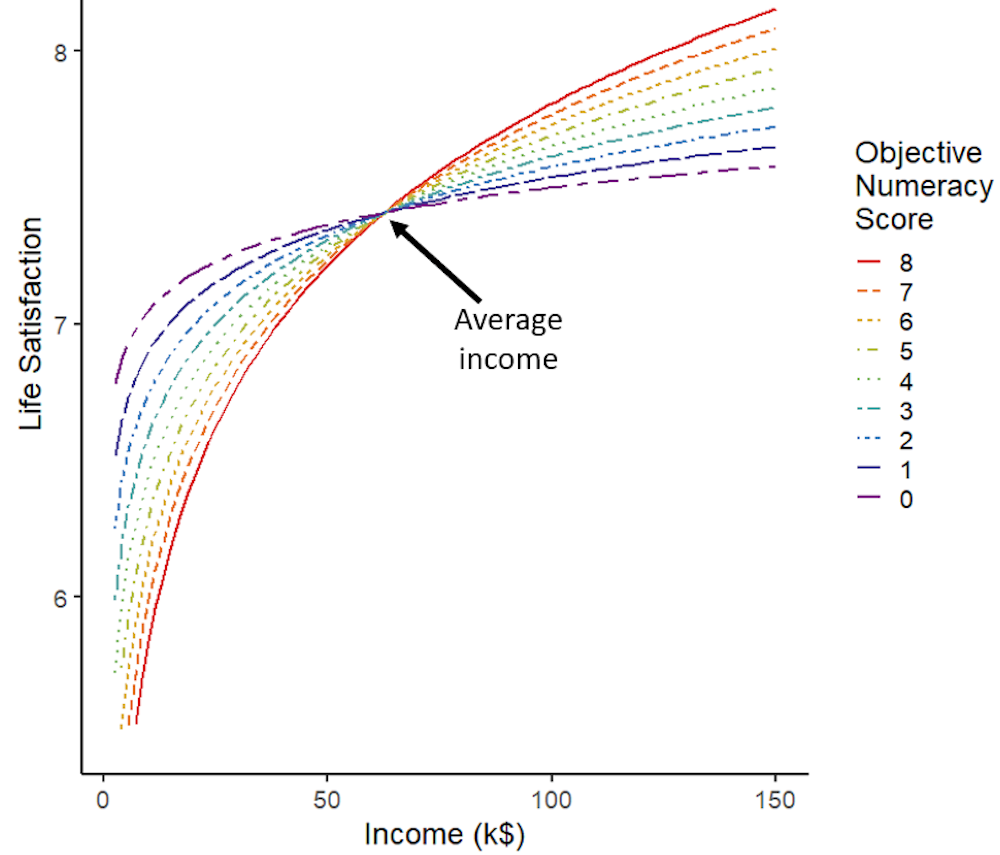
A graph correlating math skills to life satisfaction and income.
This chart shows that people who scored highest on the math test (red line) appear to be happiest when they make a lot of money (top right of graph), but also the least satisfied when they make less money (bottom left of graph). Different color lines correspond to the number of math questions answered correctly. Ellen Peters, Pär Bjälkebring, CC BY-ND

Simply put, the better a person was at math, the more they cared about how much money they make. People who are better at math had the highest life satisfaction when they had high incomes. But deriving satisfaction from income goes both ways. These people also had the lowest life satisfaction when they had lower incomes. Among people who aren’t as good at math, income didn’t relate to satisfaction nearly as much. Thus, the same income was valued differently depending on a person’s math skills.

Money does buy happiness for some

An often-quoted fact – backed up by research – says that once a person makes around $95,000 a year, earning more money doesn’t dramatically increase satisfaction. This concept is called income satiation. Our research challenges that blanket statement.

Interestingly, the people who are best at math did not seem to show income satiation. They were more and more satisfied with more income, and there didn’t appear to be an upper limit. This did not hold true for people who weren’t as talented at math. The least math-proficient group gained more satisfaction from income only until about $50,000. After that, earning more money made little difference.

For some, money does seem to buy happiness. While more work needs to be done to really understand why, we think it may be because math-oriented people compare numbers – including incomes – to make sense of the world. And maybe that’s not always a great thing. In comparison, those who are worse at math appear to derive life satisfaction from sources other than income. So if you are feeling dissatisfied with your income, maybe seeing beyond the numbers will be a winning strategy for you.The Conversation

Pär Bjälkebring, Assistant Professor of Psychology, University of Gothenburg and Ellen Peters, Director, Center for Science Communication Research, University of Oregon

This article is republished from The Conversation under a Creative Commons license. Read the original article.


People who are bad with numbers often find it harder to make ends meet – even if they are not poor


Wändi Bruine de Bruin, USC Dornsife College of Letters, Arts and Sciences and Paul Slovic, University of Oregon

The big idea

People who are bad with numbers are more likely to experience financial difficulties than people who are good with numbers. That’s according to our analyses of the Lloyd’s Register Foundation World Risk Poll.

In this World Risk Poll, people from 141 countries were asked if 10% was bigger than, smaller than or the same as 1 out of 10. Participants were said to be bad with numbers if they did not provide the correct answer – which is that 10% is the same as 1 out of 10. Our analyses found that people who answered incorrectly are often among the poorest in their country. Prior studies in the United States, United Kingdom, the Netherlands and Peru had also found that people who are bad with numbers are financially worse off. But our analyses of the World Risk Poll further showed that people who are bad with numbers find it harder to make ends meet, even if they are not poor.

When we say that they found it harder to make ends meet, we mean that they reported on the poll that they found it difficult or very difficult to live on their current income, as opposed to living comfortably or getting by on their current income.

Our analyses also indicate that staying in school longer is related to better number ability. People with a high school degree tend to be better with numbers than people without a high school degree. And college graduates do even better. But even among college graduates there are people who are bad with numbers – and they struggle more financially.

Of course, being good with numbers is not going to help you stretch your budget if you are very poor. We found that the relationship between number ability and struggling to make ends meet holds across the world, except in low-income countries like Ethiopia, Somalia and Rwanda.

Why it matters

The ability to understand and use numbers is also called numeracy. Numeracy is central to modern adult life because numbers are everywhere.

A lot of well-paying jobs involve working with numbers. People who are bad with numbers often perform worse in these jobs, including banking. It can therefore be hard for people who are bad with numbers to find employment and progress in their jobs.

People who are bad with numbers are less likely to make good financial decisions. Individuals who can’t compute how interest compounds over time save the least and borrow the most. People with poor numerical skills are also more likely to take on high-cost debt. If you’re bad with numbers, it is hard to recognize that paying the US$30 minimum payment on a credit card with a $3,000 balance and an annual percentage rate of 12% means it will never be paid off.

What still isn’t known

It is clear that people who are bad with numbers also tend to struggle financially. But we still need to explore whether teaching people math will help them to avoid financial problems.

What’s next

In her book “Innumeracy in the Wild,” Ellen Peters, director of the Center for Science Communication Research at the University of Oregon, suggests that it is important for students to take math classes. American high school students who had to take more math courses than were previously required had better financial outcomes later in life, such as avoiding bankruptcy and foreclosures.

Successfully teaching numeracy also means helping students gain confidence in using numbers. People with low numerical confidence experience bad financial outcomes, such as a foreclosure notice, independent of their numeric ability. This is because they may not even try to take on complex financial decisions.

Numerical confidence can be boosted in different ways. Among American elementary school children who were bad with numbers, setting achievable goals led to better numerical confidence and performance. Among American undergraduate students, a writing exercise that affirmed their positive values improved their numerical confidence and performance.

Other important next steps are to find out whether training in numeracy can also be provided to adults, and whether training in numeracy improves the financial outcomes of people who do not live in high-income countries.The Conversation

Wändi Bruine de Bruin, Professor of Public Policy, Psychology and Behavioral Science, USC Sol Price School of Public Policy, USC Dornsife College of Letters, Arts and Sciences and Paul Slovic, Professor of Psychology, University of Oregon

This article is republished from The Conversation under a Creative Commons license. Read the original article.